
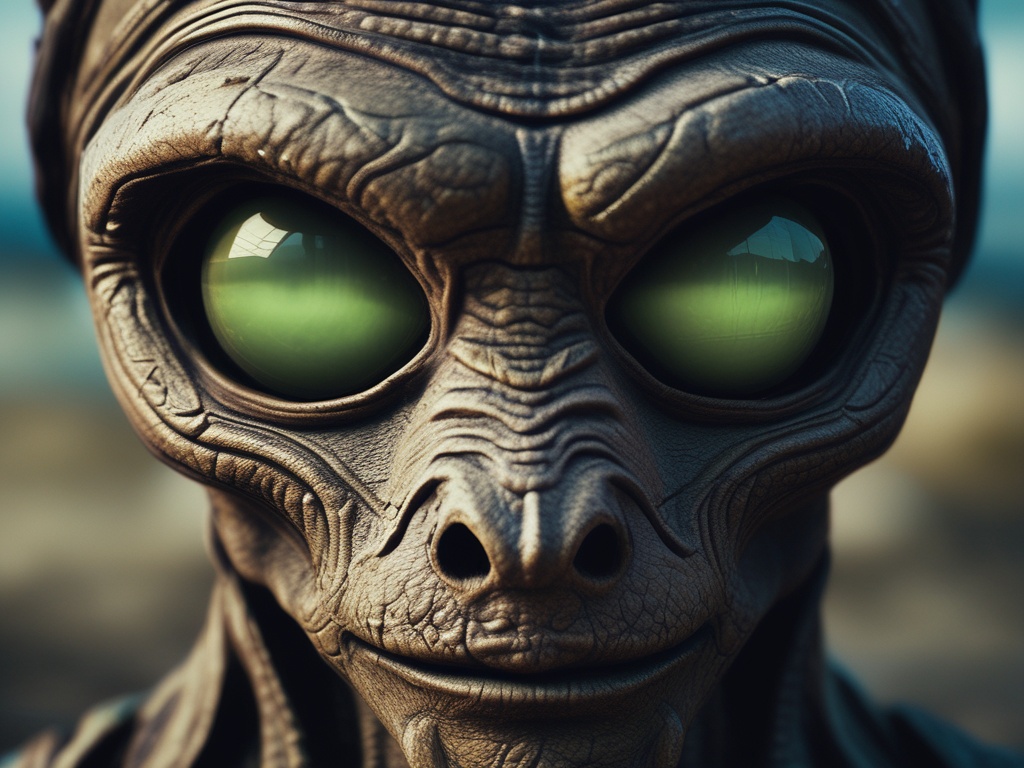
Beware of Aliens bearing gifts!

In one of my favourite TV series of the 1980’s, ‘V’, humanoid alien visitors arrive on earth to ask for our help. In return, their leader, John, promises to share the benefits of their advanced technology with humanity. The ‘Visitors’ are predatory reptilian creatures disguised as humans. The Visitors are scheming to plunder Earth’s resources while salivating over using humanity as a food source. In one scene, the resistance movement takes over a public event at the Los Angeles Medical Centre where the alien leader is about to announce a cure for cancer. The resistance seize control of the medical centre. The resistance leader, Julie Parrish, rips John’s mask off to reveal his true reptilian nature and says defiantly:

 “The visitors are not our friends…they’ve come to rape our planet and kills us…they are not who they appear to be…’’ she says defiantly to the astonished guests.

While ‘V’ was a ripping good yarn, the underlying premise was interesting. Usually, for evil to succeed, it masks itself or comes disguised as something good and beneficial. I had a similar experience at a party many years ago. After talking with a stranger, he looked at me intensely. The kind of hypnotic stare that snakes give while they slowly circle their prey. Nervously, while making small talk, I said: 

“I want to travel…go back to India…see a few other places I haven’t been’’.

He moved slowly closer to me and without blinking responded.

“Sounds great…you’ll need a big income to fund your dreams’’.

Looking at me with a reptilian stare, he paused and added…Have you heard of `the plan?’

Feeling I was unable to escape, he talked about “sharing the plan” with me. I’ve had previous ‘close encounters’ with people who wanted to share “the plan” and the dream of “financial freedom”. This was another introduction to multi-level- marketing (or MLM) or Pyramid schemes. MLM schemes make money by recruiting people into the ‘business’. People who rise to the top of the pyramid benefit financially from the people at the bottom who buy motivational resources. As a friend said to me “Same old story…they sell the dream of financial freedom through money”. I had a close friend who was ‘seduced’ by the allure of a well-known MLM scheme.

After a robust or strongly worded discussion with the friend who had become ‘possessed’, he stated to my disbelief that you could not fail. Financial freedom is guaranteed if you apply the principles and methods of the “business”. If you work hard enough, you will reap the rewards of financial freedom. If you don’t achieve financial freedom, then it’s your fault. In a cruel twist, the apprentice is blamed if they don’t succeed. The plan is a form of technology that enslaves the willing participant. And plays upon our dreams or desires for a better life. The lie has a power of it’s own. It’s a spiritual force that beguiles or seduces people who want to believe there is a guaranteed formula to make money. Fortunately, the host interrupted the conversation. I had an excuse to leave before he could get his fangs into me.

First contact and a few jokes to break the ice.

If Aliens possess the technology to travel over vast distances of the galaxy, then why don’t they have a highly sophisticated sense of humour! None of the reported close encounters with aliens are funny or even mildly amusing. Aliens, in fiction or stories of close encounters, are usually depicted as highly intelligent or evolved. Humour, according to research, is an indicator of high intelligence.

You would think that a technologically advanced alien race would be very witty. Intellectually, we are like ‘small children’ compared to our more advanced space travellers. Surely it wouldn’t take too much to make us laugh. For a species that are obviously superior and advanced, a few self-deprecatory comments would really build some rapport. I mean, making fun of yourself, is one of the easiest ways of building rapport and putting people at ease.

Some unwanted advice or ‘mansplaining’ to our alien friends.

If my dentist or Doctor can crack a few lame jokes, surely it’s not too much to ask our Alien visitors for a few jokes while they’re abducting people for further study. If Aliens were serious about making a connection with earthlings, then a few jokes or witty comments wouldn’t go astray. At least on earth, we usually offer someone an alcoholic drink or a hot beverage as social lubricant or ice breaker when getting to know people. And another thing. Many abductees tell horrifying or really scary stories of aliens taking skin tissue or organ samples. I really don’t get it? What do they do want with all the human tissue samples? Are they trying to build a human being out of spare parts? How about some empathy? On earth, we don’t kidnap people against their will, strap them to a table and examine, poke and prod them with needles and suction devices. We have consent laws on this planet!

Outer space or closer to home?

Not all the researchers of UFO phenomena believe view that a race of technologically advanced beings have been making visits to our planet. Bucking the conventional explanation, French astronomer, Dr Jacque Vallee put forward the ‘multidimensional visitation hypothesis’. Dr Vallee theorized that extraterrestrials were not visitors from outer space but spirit-like beings from other dimensions beyond our time and space. Like ghosts, visit undetected while co-existing with humanity. Nonetheless, explanations in the realm of the ‘paranormal’ are usually dismissed or excluded as a possibility.

Calling occupants of interplanetary craft

After many frustrated and unsuccessful attempts to communicate telepathically with alien beings, I became resigned to living on planet Earth. Maybe it was a way of channelling my emerging adolescent energy into something bigger than my own day to day concerns. While I was too scared to talk to members of the opposite sex, I was not afraid of making a close encounter of the third kind with alien beings. This was less intimidating…even in the face of scary testimonials of abductees being experimented on, taken aboard a flying saucer and being subject to strange and unusual medical examinations.  Nothing compared to the sheer terror of trying to make small talk with a member of the opposite sex…who…may as well have been aliens as they were a complete mystery to me. After reading some disturbing accounts of close encounters, perhaps, I was lucky not to have my wishes fulfilled.  

The lure of occult mysteries

mystic woman with candles and divination cards
Photo by Mikhail Nilov on Pexels.com

There was a natural progression and overlap with the occult as I sought to uncover the hidden mysteries of the universe. Like many searchers, I put these ideas on a pedestal to worship, admire and organise my life around. After many unsuccessful attempts to communicate telepathically with aliens, I moved deeper into investigating occult practices. The occult held out or had the promise and potential of exercising more personal power to effect change in the circumstances of my life.  The promise of more personal power or self-efficacy is the same the catalyst that motivates me to embrace the entrepreneurs journey.

Next blog post: A prophecy in ‘Babylon’.

Failure: Life as a tragicomedy

Comedy gives way to tragedy when someone refuses to learn from their mistakes. Tragedy is watching some repeat the same mistakes while expecting a different outcome.  

Photo by Capotina Entretenimientos on Pexels.com

Audiences love and enjoy the silliness and absurdity of the clown character. “Clown logic” as a clown tutor said, is the character doing the same thing repeatedly to the point of absurdity”. The clown’s failures by their very nature are a mirror image of our comical attempts at life. Clowning can help us face difficult truths, free us from unnecessary suffering, and allow us to embrace creativity and playfulness. 

The dark side of the fool

The clown or fool’s optimism, playfulness, and innocence have a dark side. Innocence and simplicity are delightful in children. In adults, being ‘simple’ can lead to disastrous consequences. The simple fool is open to any passing impulse, thought, or fad. Simple fools have an oversimplified view of the world. They fail to understand the cause and effect sequences that affect every area of their life. Clowns are like this. A pair of clowns are walking past a hospital and hear a call for a surgeon over the PA system. One clown looks to the other and says: “I could do that.” They decide to put on a white coat and a mask. The clowns then play hospital. The simple fool lacks discernment. They have the ability to sift right from wrong. They can also judge shades of grey when making good decisions. The clown or fool embodies optimism, playfulness, and innocence, but these traits come with a darker side. While innocence and simplicity can be charming in children, in adults, being overly ‘simple’ can lead to disastrous consequences. Simple fools are easily influenced by any passing impulse, thought, or fad, resulting in an oversimplified world view. They often fail to grasp the cause-and-effect relationships that impact various aspects of their lives.

Consider a pair of clowns walking past a hospital. They hear a call for a surgeon over the PA system. One clown turns to the other and says, “I could do that! Let’s put on a white coat and mask and pretend to be doctors.” This shows how the simple fool lacks discernment. They lack the ability to evaluate and judge right from wrong. They also fail to recognize shades of gray when making decisions.

 The tragic side of failure

To attempt or try anything new or different is take the risk of making mistakes.  Some mistakes are much harder to recover and have longer-term consequences.  Playfulness, spontaneity, and a live-for-the-moment philosophy can lead to impulsive decision-making without the thought of long-term consequences. Comedy gives way to tragedy when someone refuses to learn from their mistakes. Tragedy is watching some repeat the same mistakes while expecting a different outcome.  

Reclaiming our foolishness.

We can ‘play the Fool’ or be ‘played by the Fool’. Linguistic distinctions are important. A foolish person lacks judgment. They make poor decisions. Such people often repeat the same mistakes without changing or reflecting upon their behaviour. The disowned fool manifests in repetitive and tragic behaviour. You’ve observed someone at work or in another setting. They seem to be incapable of learning. They fumble their way through making one mistake after another. As an onlooker, their attempts resemble comedy of tragic dimensions. Some psychologists classify this behaviour as a form of narcissism. A narcissist has an inflated view of themselves, verging on grandiosity. A person ‘played by the fool’ resists any attempts to learn from others and refuses to accept help or assistance.

The wise Fool as an ally in the game of life

Acknowledging our “self-deception” is essential for becoming a wise fool. Some honest and painful self-reflection is necessary. It helps in understanding the behaviour patterns that keep us stuck in the tragicomedy of life.  

Step into your Adventure

We need a new kind of explorer, a new kind of pathfinder, human beings who, now that the physical world is spread out before us like an open book with the latest geographical mystery solved and the highest mountain climbed, are ready to turn and explore in a new dimension.

Laurens Van Der Post.

Photo by Alex Azabache on Pexels.com

Travel and the external quest for Adventure

The word `adventure’ conjures up images of intrepid explorers in far-off lands. Traditionally, adventure was the privilege of a select few. Only the very wealthy could fund overseas adventures. There were also incredible risks involved. While getting `Delhi-belly’ during a backpacking trip in North India was a nuisance, some traditional adventures cost explorers their health and their lives. Cheap airfares, the internet and social media have opened up the world in ways that people could not have previously imagined.

In an increasingly interconnected world, exciting new places are being discovered at a furious pace. It’s like time and space have become compressed. Recently, I participated in a webinar with people from around the world including a Hindi- speaking woman from Colorado and an Egyptian man who lives in Cairo. The exhilarating rate of discovery comes with the loss of the old definition of adventure. There are fewer, untouched areas of the planet that have been left unexplored and untouched by tourists.

The age of mass travel opens up the world.

As airline travel began to emerge in the fifties and sixties, the possibility of mass travel around the world became a reality. In the 1960’s, Sean Connery as fictional spy, James Bond, catalysed the imagination of the public as he embarked on exhilarating overseas adventures. James Bond movies have long been able to draw on audiences’ desire for escapism, exotic locations, and danger. Airline travel was still very expensive and a novelty for most people. If airline travel was too expensive, movie-goers could relax and enter the imaginary world of agent 007 as he jetted around the world on assignment.

James Bond (and other fictional heroes) encouraged us to discover many of these locations for ourselves. On my first backpacking trip to Udaipur, (South India) in 1999, I stayed in a hostel. I was exploring the possibility of doing community development in North India. From the balcony, I could see the famed Lake Taj Palace.  The Taj Palace was one of the locations for filming Octopussy. Every evening, the hotel owners placed a well-worn VHS copy of the movie, Octopussy in the video machine to the delight of tourists.

The threshold for adventure increases.

In an age of mass travel, audiences are more sophisticated and have a higher threshold for adventure. Our thirst and craving for new and original or exotic experiences is difficult to satisfy. Bond movies adapted to satisfy the growing expectations of moviegoers for exotic locations. The most recent Bond movie, `No Time to Die’, was set in multiple countries around the world. Finding exotic locations is a real challenge. There are fewer unknown areas, groups, or localities that have not been exposed to the influences of Western culture or tourists.

During the 1980s, I went to see the movie `The Last Emperor’, with a friend. The movie is based on the story of the last monarch of the Qing dynasty in China during the Japanese occupation in World War 2. I looked around to see my friend, Emily sobbing quietly. After the movie was over, I asked Emily why she was crying. A normally chatty and vivacious person, Emily paused to gather her thoughts. She looked at me and said: `I was crying over the end of an era’.  Emily explained that she felt the loss of old-age traditions and exotic locations. A musician once told me: `If you want to get a taste or an experience of traditional music cultures or untouched cultures…you might have better luck in the diaspora s people cling or value their traditional culture more when in a foreign land or new country.

The end of adventure or the beginning of something new?

The absence of undiscovered or novel locations is not the only challenge to traditional notions of adventure. There is also the risk of over-exposure and familiarity. Our innate restlessness, yearning for adventure, and thirst for new experiences can never be fulfilled. Traveling will never totally satisfy a deep desire or longing in our hearts. As a wise man once said, we have “eternity in our hearts,” a restlessness and desire within to be a part of a larger cause or a story bigger than ourselves. The slow demise of traditional notions of adventure presents an opportunity. A challenge to reimagine the concept of adventure.

Life is an adventure:  finding adventure in everyday life through self-discovery.

Photo by Andrea Piacquadio on Pexels.com

A new breed of explorer has emerged: one who looks within and is interested in self-discovery and learning. Regardless of where they live, the true explorer seeks out new experiences and challenges. There are internal adventures that ask us to go beyond our known or fixed concepts, into dark and unpleasant areas, and confront ourselves before we can break through. On his/her journey, the explorer encounters all of his anxieties, causes that have become strongholds or mental prisons. He must overcome his fear of appearing ‘foolish’ before he can become competent and have a genuine chance of changing jobs or improving his relationships. You can make a simple day adventurous by stepping out of your ordinary routine, trying different things and experiencing life in new ways.

In my next blog post, I will elaborate on why re-imaging Adventure will become more important in the next decade.

My personal quest for adventure

Photo by Valentin Antonucci on Pexels.com

When I was in my early teenage years, I started looking for adventure because I was feeling restless and discontented. I was always curious and enjoyed learning about new places, which motivated me to venture outside the realm of what I knew.

Adventure as the discovery of the external world.

In my early years, I thought of adventure as exploring the outside world. In
a  scene from the `Temple of Doom’, Indiana Jones’s sidekick, Short Round, asks him a question about the Shankara stones. Indiana Jones provides a concise explanation of his motivation: “Fortune and glory, kid, fortune and glory.” My fortune and glory were a career in politics. I gravitated to journalism. I thought this would be a practical path to a political career.

While journeying through the external world, I could no longer ignore my interior world. Like a lost traveller, I was overcome by what I
saw. I cautiously moved from the outward to the inner world to navigate through my darkness and confusion in the quest to the `treasure’. The treasure as represented by discovering the purpose of my life.   

The quest for adventure: exploring my internal world.

The unconscious is the land of the internal world. I was a reluctant
explorer, but after a period of travelling in India for 3 months during the
early nineties, I returned home to Australia feeling spiritually distraught,
confused and more fearful than ever before. There was something about this trip that touched a raw nerve inside of me. The pain and confusion of self-sabotage behaviour pushed me to go deeper into my inner world and find out what was going on beneath the surface. My India adventure had peeled back the layers to uncover my inner wounds–but it wasn’t all bad news! A whole new world revealed itself to me in greater depth: one that is mysterious and fascinating. A world expressed through the language of dreams, synchronicity and self- awareness.

Finding the hidden treasure or the `gold’ refined in the fires of
adversity.

I looked inward and found the treasure I had been searching for. In the
fires of adversity, I discovered the gold refined through my struggles. The
precious gold that came from the important life lessons and wisdom achieved along the way developed through facing adversity and uncertainty. Adventure is moving out of my comfort zone beyond what I can control and predict. It is being open to new experiences and the willingness to risk failure. Learning to embrace failure without harsh self-judgment was going to be one of my biggest personal challenges.

The next phase of adventure: the entrepreneur’s journey.

After a particularly difficult time in mainstream employment, I was
increasingly drawn to the idea of self-employment. I decided to commit to the entrepreneur’s journey. Like the promise of buried treasure, the dream began to call on me until I could no longer ignore the call. It could be starting a business, following your dreams, starting a family, quitting a job or following your dreams. There are adventures waiting to be discovered in the day- to- day routines of life.


Games Religious People Play: `Fig Leaf’.

Fig leaf is a reference from the story of Adam and Even in the garden of Eden.

The serpent said to the woman, “You won’t surely die, for God knows that in the day you eat it, your eyes will be opened, and you will be like God, knowing good and evil.” (Genesis 3: verses 4-5 WEB translation)

Adam and Eve disobeyed God and ate from the tree of knowledge and Evil. Apart from an awareness of sin, Adam and Eve soon realised that taking advice from a talking snake was a really bad idea. Like many difficult couple relationships, they blamed everyone else for their problems. Eve blamed the snake and Adam blamed Eve for eating the fruit. Sin entered the created world and spoilt everything for humanity. An ongoing tragedy was the proliferation of awful marriage or relationship `self -help’ and `motivational’ sermons and books.

Books with titles like `Seven Keys to a Dynamic Marriage’, `Getting Back Your Sassy Self’ and `Co-dependent No-More’ have been making publishers and relationship gurus filthy rich since the late 20th century. Fig leaf is also a figure of speech. It describes using something that is inadequate as a cover to hide shame and embarrassment. Fig Leaf is also a game. Fig Leaf occurs when well-meaning Christians adopt the latest social issues or programs to gain credibility or popularity with the powerful and the public.

Fig leaf is sometimes very hard to spot. Especially when the cause is good and worthwhile. For example, a church installs solar panels to reduce carbon emissions and `raise awareness of climate change’. The game of `Fig Leaf’ is played when the cause is used as a cover or `Fig Leaf’ to hide their insecurities or unbelief. In the absence of convictions, Christians are tempted to co-opt every passing fad or trend as a `Fig Leaf’. Somewhere along the path of good works, the focus switches from being other centred to `virtue signalling’ or `Look at me…look at me’.

What is virtue signalling?

Virtue signalling is usually described as any communication that involves expressing a moral viewpoint with the aim of demonstrating good character or moral virtue. In the negative sense, `virtue signalling’ is contrived and empty. Virtue signalling can come across as insincere and empty. The focus is on the activist’s self- image with little or no cost or personal sacrifice. In virtue signalling, the signaller’s main aim is to make a positive impression upon their audience. It plays into our desire to look good in the eyes of other people.   

 Humans want to be good.

Regardless of what we believe (or don’t believe), humans have a natural inclination to want to be `good’ or `right’ and seek justification in what we do (or don’t’ do). We are `hard wired’ for striving to attain a standard of virtue or righteousness. In the gap between the ideal and the reality, we always fall short. Simply doing more of the same will never fill the void or satisfy the inner restlessness, insecurities, critical voices and fears. Excessive virtue signalling has been linked to blindness…um…spiritual blindness that is. Using causes as fig leaves blinds us to the reality that we cannot be `good’ or `righteous’ through our own self-efforts.

In a follow up post, I will explore a better game to `Fig Leaf’ and an alternative look at virtue signalling.

The narrow path: `playing to our strengths’.  

Learning to understand and use our giftedness is one of the guideposts of a life based on grace

It’s Harry’s Birthday. He comes home from work one day and finds a letter in the mailbox. Harry slowly opens the letter and finds a birthday card inside. As he opens the card, a ticket falls out onto the ground. He bends over to pick up the ticket. Harry squints while reading the fine print on the ticket. He says out loud `This is too good to be true!’ The ticket grants the holder `all expenses paid, unlimited overseas travel’ to any location in the world for a period of five years.

Harry’s first excitement at his birthday present starts to give way to some uncomfortable thoughts and feelings. He starts to feel ashamed. Shame is the feeling that suggests `there is something wrong with me…I really don’t deserve an expensive gift like this… I don’t deserve this’. Feeling slightly cynical, Harry thinks to himself `What’s the catch…there’s gotta be catch’.

After a brief pause, Harry puts aside his negative thoughts and receives the birthday present with a feeling of gratitude. He is excited about all the possible places he would like to travel, the tours and adventures that lay waiting for him. Harrys’ good fortune takes an abrupt turn for the worse three days later. He receives an official looking letter in the mail. `Maybe it’s a cheque…a refund or some other good luck’. Harry opens the letter while squinting to read the print. In the letter is an invoice for the travel ticket with a request to pay within 14 days.   

What is grace?

Grace is hard to explain. Looking at the opposite of grace is easier for most of us to understand. The opposite is like getting an invoice for a birthday gift.  A gift is something good we receive with `no strings attached’ and is usually unearned. While the motives for gift giving can be tainted or corrupted, there is an expectation that we don’t have to earn a birthday present. If birthday presents were conditional on our good behaviour, then most of us would be very disappointed around our birthdays. Not all gifts are external. All of us have gifts in the form of hidden abilities, talents or life experiences that have shaped us for the better.

Playing to our strengths.

Strengths based approaches are very popular in the helping professions. Strength based approaches have this view in common: everyone has potential strengths and abilities that are hidden, partly expressed or utilised. People grow and develop when we encourage and help them `play to their strengths’ and not simply define a person by their problems or see them as the problem. We are all `gifted’ in some way or another. Some people are more physically gifted – have stronger, naturally athletic bodies, a razor-sharp intellect or other natural abilities that give them a head start in life.

How grace is expressed: learning to understand and appreciate our abilities, talents and gifts.

Learning to understand and use our giftedness is one of the guideposts of a life that is based on grace. The character of `Harry’ used in the story was born with a strong sense of optimism. While he was not academically smart in the classroom, Harry had a natural ability to learn practical skills in a real-life environment. This gave him a feeling of mastery and confidence in his work and hobbies. He also gained the respect of his extended family and work colleagues. I once spoke to an older man who radiated joy when he talked about his work role. He was the CEO of a training college. He had found a role that was natural fit with his abilities and life experience. He told me that his work was `play’.  His honesty about the challenges and difficulties in his role as CEO gave his story credibility and authenticity.

The expression of grace in our lives.

  1. Think about something you do that comes naturally without much effort or training. (maybe partly realised and not fully expressed)
  2. How is this expressed in your life?
  3. What label would you use to describe these abilities and talents? (you may need to ask another person to help you with this process. We are usually unaware and reluctant to admit our strengths).

Second level of play : Hedonism – the pursuit of pleasure.

Pleasure is a helpful tonic for the overly serious and over responsible.

Whiny Simon looking `concerned’.

Hedonism is the pursuit of pleasure and the desire to minimise pain and suffering. Hedonism is the dominant philosophy of the western world. Hedonists believe and hope that having our desires fulfilled will bring us happiness, pleasure and joy. Pleasure is a helpful tonic for the over serious and responsible. Jesters, clowns and fools bring playfulness, spontaneity and joy to the ruler’s court when it is most needed.  

Bringing life to work: the benefits of pleasure.

Jack `the amateur tech guy’ gets enormous pleasure from problem solving his co-workers computer problems. He enjoys feeling helpful and achieving a sense of mastery over technical problems. Jack’s banter and good humour helps relieve the grind of the day to day routine of office work. Jack likes to show off his cooking skills by bringing a home- made cake into the office staff afternoon teas. Jill suggests the staff team bring their pets to work once a month. The team really enjoyed showing off their `fur children’ and having animals around the office. This lifted office morale and injected some fun and novelty into the workplace. Playful eruptions disrupt and suspend the routines and habits of work and whisper to us provocatively: `work is not an end in itself.’ Play is an invitation into the realm of pleasure , freedom and aliveness.

The dark side of hedonism.

Whiny Simon first became aware of the negative impacts of climate after one of his many overseas trip. Whiny Simon is ‘very concerned’ about climate change issues – particularly on the poor and vulnerable. He also loves to travel and has racked up many frequent flyer points. He felt a twinge of discomfort and inner conflict that his lifestyle was adding to the problem of global warming. Simon resolved this problem by ignoring it! He decided to mix business and pleasure by adding some volunteer work to his holiday plans. There were many opportunities to assist building orphanages and other projects.  After the end of the lockdown, he is looking forward to more overseas adventures to help the poor.

Hedonism has a dark side. It can be a way of avoiding suffering and pain. A temporary sedative or analgesic  – like  the advertisement says: `relieves pain and brings temporary relief.’ As an avoidance, hedonistic pleasures numb us to the pain and discomfort that can motivate us to make changes to our lives. Dissatisfaction is a great motivator to go beyond the existing `playing by the rules’ story and explore other alternatives ways of living.

The pursuit of pure hedonism is self-defeating and leads to failure. As an end in itself, hedonism does not produce long term satisfaction or happiness. Avoiding suffering in all it’s forms, ultimately minimises our ability to gain satisfaction. The satisfaction that comes from facing obstacles, striving for a better life or a more inspiring and uplifting life – this is not a life free from suffering but learns to embrace discomfort and suffering for a higher purpose.

Levels of Play: playing by the rules.

Hard work and getting qualified works for most of us. Some people manage to find work they really enjoy or find meaningful…Rules provide a level of security, predictability and communicate clear expectations around human behaviour.

Play has many layers of depth. `Playing by the Rules’ is the first level of play. It goes like this – get an education, an apprenticeship or a tertiary degree. Those who are lucky enough will get a secure, high paying job or start a successful business. This is the ticket to buying a house, a mortgage and being more attractive to a potential partner. We exchange time, money and energy for financial security, status and the things that money can buy. There are exceptions to the rule. Some people choose singleness as a `lifestyle choice.’ For others, a relationship breakdown, death of a partner or the imbalance between the sexes may mean temporary or long-term singleness through no fault of their own.

Let’s look at a `fictional’ couple called `Jack and Jill’. Jack and Jill climbed the hill of education and secured good jobs. They have a house in the suburbs with a large mortgage, 2 children, a daughter and son (Charlie and Travis) and a dog called ruffles. Jack and Jill will spend most of their lives working to pay off a house (and any other debts). They want to accumulate enough superannuation for a comfortable retirement. Outside of work, Jill really enjoys her weekly yoga class and likes reading self-help, motivational books like `Women Who Swim with the Sharks’, `Fearless Woman’ and `The Power of Me.’ Jack loves his Australian Rules Football, fixing things and is an avid reader of sports magazines. They both love Netflix and renovation shows. Jack and Jill are a `down to earth’, practical couple who are very accepting of other people.

In their retirement, Jack and Jill plan to travel, spend more time on their hobbies and are hoping for grandchildren. Jack and Jill aren’t religious people. Jack thinks churches are full of ` money grubbing-hypocrites’. Jack can put aside his opinions and relate well to people in general. Jill has some vague, fleeting thoughts on the possibility life after death. Jack and Jill are very self- reliant people. If there is no God or certainty beyond this life; then we must strive to look after ourselves and each other. In a universe where God is absent; we are all alone. Like cosmic orphans, we must look to our own efforts to survive through extended family, friends and relying on the state. 

Jack is very popular around the office. He’s very good at fixing things unlike `whiny Simon.’ Jack likes to help his co-workers with their computer problems. He has a practical knack for learning new skills and teaching others. Whiny Simon is usually ‘too busy’ to help other people. He always has time to ‘volunteer’ his opinions about the latest social cause or grievance to his jaded co-workers. Whiny Simon is a humanitarian; an advocate for many a good cause who dislikes people. Shaking his head in dismay, Whiny Simon can’t believe that most people stubbornly cling to their ‘outdated’ and `reactionary’ views that hold back progress. Whiny Simon prides himself on being ‘outspoken’. He loves posting on Facebook to share his thoughts with a broader audience. People usually find excuses to avoid Whiny Simon at work.

Jill is admired by her peers for her calm temperament and ability to make good decisions in stressful situations. Jill’s boss, Steve, nominated her for an `Emerging Leaders’ program at work. Jill struggles with another co-worker, Georgia or ‘Regan’. Georgia was nicknamed Regan after the young female lead character in the movie, `The Exorcist’, who was possessed by a demon. Some of Georgia’s co-workers believe she is possessed by an evil spirit. Georgia’s icy, cold presence causes the room temperature to drop by 10 degrees whenever she enters the office. Ruby the admin officer joked that everyone was waiting for Georgia’s head to rotate around 180 degrees while the demonic spirit openly manifests itself. Georgia resents Jill because she received a promotion for her good work. Georgia can’t understand this. ‘I’ve been in the job for six months…. where’s my promotion?’, she thinks to herself. Georgia feels that she is a victim of a massive systemic injustice.

Playing by the rules has many advantages.

Hard work and getting qualified works for most of us. Some people manage to find work they really enjoy or find meaningful. Jack and Jill have more freedom, comfort and choice over their lives. Rules provide a level of security, predictability and communicate clear expectations around human behaviour. What if Peter, the payroll officer decided to give into his non-conformist playful streak and take 4 weeks holiday leave without going through the formal leave application processes. While Peter is laying on the beach at Bali enjoying the sound of the waves breaking onto the sand, his angry co-workers can’t understand why they were not paid this fortnight. Whiny Simon and Georgia have the time to ride their favourite hobby horses and pursue grievances. For many people who are materially poor, life is a struggle to get the basics and with fewer options. Involuntary poverty is not much fun. People who ‘play by the rules’ can be very resentful of other people who `don’t pull their weight’ or the `work shy’ like their welfare dependent neighbours. Adversity is the great leveller of social status. We are only one accident away from being on a Disability Support Pension.

The downside of playing by the rules: ‘wage slavery.’

There is a downside to exchanging time, money and energy for financial security. The promise of having a `great career’ fades like a desert mirage in the grind of the daily routines of work. The mind-numbing reality of being stuck in a cubicle or open plan office doing repetitive tasks starts to wear thin. Collaboration is difficult when other people have mentally `clocked off’ and have low levels of motivation. Jill would like to find another position to avoid having to work with Georgia. This is not possible for Jill as she cannot afford to take a pay cut. The fear of the loss of financial security keeps many people in a state that feels like ‘wage slavery’. Most people will stay in jobs they have outgrown or dislike. Playing by the rules has another advantage. The ability to buy goods, consume experiences and pursue our pleasures self-medicates us from the mind-numbing reality of routines that become staid and boring. This dovetails with the second level of `play as hedonism’ or the quest for pleasure.

My failed career as an Astronaunt. (Part 2)

My more optimistic side hoped that Aliens would be more like characters in the original Star Trek series. You know the type. Aliens with large craniums dressed in togas would greet me through telepathic thought waves.


Photo by James Lee from Pexels

Around the same time, I became more interested in Unidentified Flying Objects. (UFO’s) I read every book that I could find on UFO’s. Most school libraries books had books on UFO’s, ghosts and creepy things `that go bump in the night.’ These books were `dog eared’, ruffled and worn out from the impact of eager school children constantly pouring over the pages. Several copies of these books went missing from my local library without any explanation. How these books disappeared from the watchful eyes of the stern faced, school librarians that patrolled the library is still an unsolved mystery.  

One book that remained on the library bookshelves was `Chariots of the Gods’, by author Erich Von Daniken. Von Daniken believed that aliens visited earth at various points in human history and contributed their advanced knowledge to the development of the human race. What motivated advanced extraterrestrial beings to take an interest in the humans? Did they think our ancient human ancestors were `slow’, ` thick between the ears’ and needed `a bit of a leg up’? How Erik Van Daniken came to write `Chariots of the Gods’ is a story in itself. Von Daniken embezzled money during a stint as a hotel manager to fund his `research trips’ to write and make a documentary of his book. He served one year of a three and a half year  prison sentence for embezzlement, fraud and forgery. He used the profits from his first book to repay his debts and support his new career as an author.

After reading `Chariots of the Gods’, I came to a startling conclusion. If Aliens could solve advanced mathematical calculations and help the Egyptians build the pyramids, they must be really, really smart! If they are really smart, then they probably had advanced telepathic powers and were looking to communicate with `more evolved’ human beings. I spent many evenings after school looking into the night sky trying to send telepathic messages to connect with alien beings.  I hoped that some aliens would teleport me into their flying saucer.

I had some slight anxiety about meeting alien creatures. I was part of a generation that was traumatised watching Sci Fi shows with cheap special effects on TV during the late sixties and seventies. Images of alien costumes made from paper mache layered over chicken wire or spray painted, green plastic bags with ping pong balls for eyes still terrorise me in my sleep. There were no trigger warnings. None of my teachers, parents or elders warned me (or my peers) of the dangers on getting on board flying saucers piloted by alien beings. This must be the ultimate in stranger danger! Seriously, I don’t know how I survived my childhood.

My more optimistic side hoped that Aliens would be more like characters in the original Star Trek series. You know the type. Aliens with large craniums dressed in togas would greet me through telepathic thought waves.

`We come in peace…finally…we’re glad to meet you…we were running out of hope that we might find intelligent life on this planet.’

Trying to decide who to make contact with on planet earth must stretched the mental capacities of our deathly pale, green tinted, toga clad friends with large heads. You would think that a highly intelligent species would like to meet with a winner of the Nobel Prize, a scientist or the leader of a major world power. Why would they choose to talk with a 10 year old boy? Only the imagination of an innocent child could believe they were the centre of the universe. Some adults never grow out of this belief.

Maybe I would be lucky. The Aliens would take me with them. It never occurred to me that I could be unlucky. Instead, I might be watching in fright as some strange, bug eyed alien leaned over me while I was strapped to a large table. The alien scientist prodding my body with electrodes while trying to decide which of my bodily organs it will remove to keep for further study. I didn’t expect this would include being dissected and having all my organs stored in a glass cannister. Meanwhile, on the bench, my brain is sitting in a glass container full of chemicals while kept alive by periodic jolts of electricity. Anyway, 44 years later, I am still waiting. Not a UFO in sight.

Space oddity: my failed career as an astronaut. (pt 1)

There were a few obstacles to my dreams of becoming an Astronaut. Reality was a really, really big one

As a child, I developed a very rich imagination. I learnt to withdraw into a creative fantasy life as a way of avoiding difficult, boring and painful circumstances. I remember `feeling different’, an `outsider’ and never quite `fitting in.’ Not an uncommon experience as an adopted child. There are many advantages to having a rich fantasy life. I could escape from the tedium of compulsory singing during school and navigate an imaginary universe. From an early age, I aspired to be an Astronaut. I wanted to travel through space; the ultimate in `disassociating’ from the limits of an earth-based reality and explore beyond the boundaries of the known universe.

There were a few obstacles to my dreams of becoming an Astronaut. Reality was a really, really big one. While patiently biding my time on planet earth, I noticed there weren’t many vacancies for nerdy, insecure prepubescent children at NASA for Astronaut training. I consistently failed primary school maths and struggled to read maps. I was also prone to feeling car sick when travelling. I couldn’t think of anything worse. Struggling to remove my space helmet while having an `out of stomach experience’ and fumbling to find the barf bag. Not a great start for an aspiring space explorer.

Photo by Lavdrim Mustafi on Pexels.com

Space travel is also very, very expensive. In the early seventies, a Saturn V rocket cost around one hundred million dollars. (or one trillion dollars adjusted in today’s currency) That’s a lot of pocket money. (not to mention the postage and handling costs!) Even if I could afford the postage, the sight of a rocket sitting in my backyard would attract the attention of my parents and neighbours. I could imagine my bemused father asking: `What’s that son?’ `It’s a Saturn V rocket, Dad…the type that launched Neil Armstrong and Buzz Aldrin to their first moon landing.’ I imagined my Dad saying in reply, `Alright… don’t tell your mother…she’ll just worry about it.’

The countdown was magnificent…10…9…8…7…6…ignition sequence begins…5…4…3…2 …1…and blast off! The liquid oxygen and kerosene fuelled rocket engines roared into action as huge amounts of fire and smoke poured out of the nozzles. The cabin shook as the rocket slowly accelerated upwards into the clear blue sky. My back arched slightly as the vibrations from the rocket engines firing rattled through the whole structure. The pressure of gravity became stronger as the rocket sped upwards into the higher reaches of the atmosphere. `Looking good Mission control’, I thought to myself. I think my neighbours would have been miffed as their houses were incinerated during the launch. I never like old Mr Jones anyway. He had a flat earth view of reality that could be summed up as `wake up to yourself’, `get a haircut son and don’t march on our streets! ‘Some people’s stance on life is like gravity. Their attitudes exert a strong downward pressure to conform and keep lofty ideals firmly from soaring into the heavens.

My hopes of becoming an Astronaut fizzled like a wet fire cracker. I remember sharing my dreams with my grade four teacher. Her lack of enthusiasm was enough to sow seeds of doubt in my mind. Perhaps she thought to herself `not another one’ or knew that my lack of aptitude for maths would doom me to be grounded on planet earth forever. Reluctantly, I had to compromise my dream of space travel. It was not long after this time that my view of reality would begin to shift. A friend gave me a copy of a book. I discovered the phenomena of Unidentified Flying Objects. If intelligent life was out there cruising the galaxy… then… maybe… they would take me with them!