
Lessons from Jean Valjean’s Transformation

Photo by Samuel Regan-Asante on Unsplash

Les Misérables tells the fictional story of Jean Valjean as he struggles for survival in 19th-century France. The tale unfolds against a backdrop of revolution, injustice, and cruelty. Valjean was imprisoned for stealing a loaf of to feed his extended family. He served a total of 19 years for his repeated attempts to escape. Les Misérables reads like a detective story. The reader follows the twists and turns of the main character’s fortunes, Jean Valjean. Traumatised by his life experience, Valjean hardened his heart and became an intensely bitter and cynical man. Upon his release from prison, the streetwise Jean Valjean undergoes a profound transformation, becoming a successful businessman and town mayor. A past crime still haunts Valjean as the dedicated Inspector Javert relentlessly chases him.

Jean Valjean knows that he could be imprisoned for the rest of his life. This could happen if Javert recaptures him and puts him on trial. It’s a great story that continues to resonate since first published in 1862. Most of us live far from the squalor and poverty of 19th-century France. Yet, Les Misérables still speaks to us directly today. His fictional life story challenges us to think about how we respond to unfairness. How can we grasp opportunities? How far are we willing to go to protect the vulnerable or live according to our conscience? By examining the decisions Valjean makes, we can uncover practical insights for our own journeys. This is especially true in how we forgive and take responsibility. It helps us choose forgiveness over revenge when treated unjustly.

Life is hard and difficulty is part of the path.

    Job 5:7 “But man is born to trouble, as the sparks fly upward.”

Jean Valjean was born into a life of poverty and struggle, shaped by societal forces.  The author, Victor Hugo, describes him as an illiterate tree pruner who made his living through physical work. A man familiar with tragedy, he was orphaned from a young age as his mother and father died. He had an older sister who was widowed with seven children. Valjean used his pitiful earnings to support his extended family. As a labourer, his livelihood was dependent on the availability of work. Like many people who sell their labour, Valjean was subject to forces beyond his control. As winter approached, there was no work for him. The spectre of starvation haunted his extended family. It is an unpleasant reality that life is unfair. Some people are born into privilege and inherit, through no work on their part, advantages and financial security. Like many of his contemporaries, Valjean was materially poor with limited options.

Orphanhood is a universal experience.

Valjean was orphaned from an early age. The orphan is the ‘outsider’ – the person who has suffered loss and trauma. Some people are literal orphans, abandoned by their parents/guardians. At other times, people experience a sense of orphanhood. They face rejection from their families or communities due to their differences. Orphans have a strong sense of ‘not belonging’ and alienation from the mainstream. You don’t have to be poverty-stricken to feel like an orphan. Sometimes people are `orphaned’ as their families or communities reject them for being different. The truth is more complex and multidimensional. .

Many people now work in cubicles in open-plan offices. Leg irons and manacles are replaced by surveillance and micro-management. Chained to their desks, alienated from their work and with little control over what they do. Psychology tells us that lack of autonomy over work leads to feeling alienated and can lead to ill health. Increasingly, many people lack work or housing. They are locked out of the economy through no fault of their own. Maybe you’re a male. You are constantly told you live in a male-dominated, patriarchal society. And yet…being male doesn’t give you any benefits or power. You feel powerless. You don’t gain even when men hold the most dominant positions. You are still on the lower rungs of society.

pexels-photo-1411421.jpeg
Photo by Wendelin Jacober on Pexels.com

I was struck by the large number of young men waiting in the queue at Centrelink. (Unemployment insurance in the United States) An older man remarked to me. He said, ‘Many of these guys found a place in the factories.’ Now, many of them are closed down’ He said while pointing to the abandoned buildings now marked by graffiti. These buildings would eventually be taken over to become artists hubs for the trendy middle class. There are also other forms or manifestations of poverty that have negative consequences, like poverty of imagination.

Poverty of imagination. In my professional role as a social worker, I discovered a significant issue. Many people from disadvantaged or marginal backgrounds had ‘poverty of imagination’. The freedom to give ourselves permission to imagine is powerful. Imagination enables us to suspend our current reality and explore the potential of what could be. Freedom invites us to move beyond the circumstances that are within our limited control. The outcome maybe failure or negative consequences—a problematic situation for people with already limited resources. In my personal life, a stunted or impaired imagination can stifle or has stifled my ability. It affects my ability to apply for higher-level, more interesting work. It also impacts my ability to form better relationships or friendships with others. Additionally, it hinders the possibility of becoming an entrepreneur or making a living through writing. As a child from a blue collar background, these ideas seem out of reach. They’re like a mirage where the oasis appears within reach and manages to elude me.

There is hope: orphans are transitional figures.“Even the darkest night will end and the sun will rise.”
― Victor Hugo, Les Misérables

silhouette image of person praying
Photo by Rodolfo Clix on Pexels.com

Orphanhood is not a life sentence. In literature and story, orphans are transitional figures. The orphan figure gives us hope. They remind us of the possibility that we can thrive and grow in hopeless and tragic situations.  Jean Valjean moves from bitterness and hatred to becoming a respected figure. He contributes to his society. He has empathy and understanding for the `Les Misérables’, those with little power, and the downtrodden. In my next post, I will discuss how we can reclaim our experiences of orphanhood. I will also explore how the orphan journey can strengthen us through their wisdom.


Defusing Conflict: Lessons from the Christmas Truce 1914 (part 2)

stained glass in a church
Photo by cottonbro studio on Pexels.com

Part 2: Avoid demonizing the enemy.

In a situation of conflict over needs, it’s all too easy to move to a default view. We often see the worst in other people. We look at others through a distorted lens while suppressing, downplaying, or minimizing our faults and flaws. Spiritual blindness leads to hatred and contempt for the other person (or group). We need to exercise sober judgment to see ourselves and others clearly. As Jesus Christ said, ‘… take the log out of your eyes. Then, you can remove the speck from your neighbour’. In his short teaching, Jesus challenged us. He urged us to acknowledge our tendency to judge others harshly. We often judge others harshly for the same behaviours within ourselves. This process of self-reflection is a powerful tool for promoting understanding. It allows us to see beyond our first perceptions, fostering empathy and open-mindedness in conflict situations.

For over 12 years, I worked in the criminal justice system to help rehabilitate youth and adult offenders.  Someone asked me: ‘How do you do it… work with criminals?’ I responded…’I’m not that much different.’ I understand that I have the potential for my own tendency towards crime or anti-social behaviour. This work has been a journey of personal growth for me. You hear the stories of the guys `doing time.’ They share the choices they made and the risks they took. You listen to the pathways that led them through decisions. You start to understand how easy it is to commit criminal acts. Then, you add other layers. The lack of opportunities and disadvantages. Add to this bad choices and a peer culture that celebrates or affirms offending.

Taking a risk.

After the first banter and carol singing, some soldiers left the trenches. They offered friendship to the opposing side. Sometimes, we must leave our trenches or fortified opinions long enough to risk meeting with the ‘enemy.’ It takes courage or chutzpah to take the first step. In the short term, staying comfortable with the familiar is more effortless. We find safe territory by taking refuge in our fixed positions, judgments, opinions, beliefs, and ideologies. The risks include confusion, uncertainty, and giving up fixed ideas. Yet, through these risks, we open ourselves to the potential for personal growth and transformation by engaging with differing perspectives. Disliking or hating someone when you are closer to them is more challenging. There was no guarantee their gestures would not be seen as a threat. Their gestures could have been met with gunfire or an attack. In the records, some soldiers were killed during this time. Yet, many took a calculated risk. They informed the opposing side. Then, they walked out onto the battlefield. They wanted to offer a hand or make a gesture of friendship.This act of understanding, of trying to see the other side, is a powerful lesson in empathy.

Find common ground.

An essential factor that made peaceful relations possible in the war of 1914 was a shared story. This story was grounded in a European Christian heritage. Shared rituals created a temporary climate of peace. People put up Christmas trees, exchanged gifts, and sang carols. One German soldier noted, “You are the same religion as we. Today is the day of peace”. Finding areas of agreement can help build trust and reasons to work together. Extended conflict is draining, wastes time and energy, and produces little or nothing of value.

Defusing Conflict: Lessons from the Christmas Truce 1914

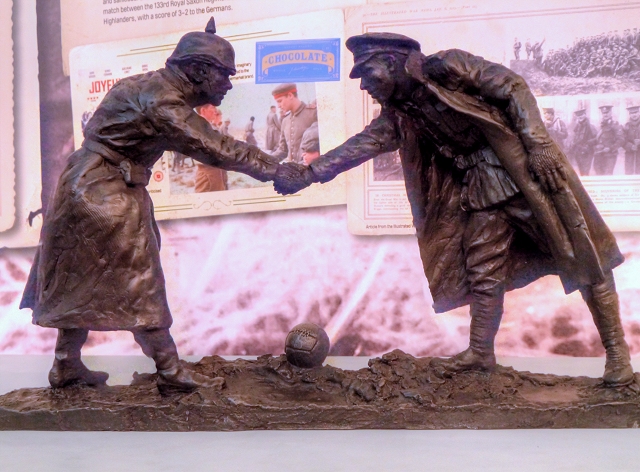
National Football Museum, All Together Now by Andrew Edwards
National Football Museum, All Together Now by Andrew Edwards by David Dixon is licensed under CC-BY-SA 2.0

Christmas is a magical time of year. Traditionally, Christmas was a time to reflect on the birth of the saviour, Jesus Christ. For many Australians, spending time with family and friends and enjoying food is the main reason for Christmas. Around the world, Christmas is celebrated by the religious, non-religious and irreligious alike. Whatever the reason, Christmas inspires many of us to be kinder and more joyful. Family tensions are put aside long enough to come together around Christmas dinner. Did someone sneakily sprinkle fairy dust that leads to a change in behaviour? Christmas can also bring out the very worst in people. Some Christmas gatherings are more like trench warfare. Where passive-aggressive sniping and verbal hand grenades are thrown into the conversation. All this served with a side order of indigestion and seething resentment. Whatever the reason, outbreaks of peace and goodwill are possible.

The Christmas truce of 1914

An outbreak of ‘peace and goodwill’ occurred along the Western Front during the first World War. On Dec 7th, 1914, Pope Benedict XV (15th) asked for an official truce. The Pope pleaded with the warring powers. He wished that “…the guns may fall silent at least upon the night the angels sang.” His appeal for peace was ignored. Since the start of the war, Allied and German soldiers had been fighting for 5 months. Thousands of men had been died (including civilians during the German invasion of Belgium). The armies on both sides were now bogged down in trench warfare. In some places, the trenches were no more 30 metres apart. As the Christmas season approached, the weather became cooler and frost appeared on the ground. For soldiers on both sides, this was their first Christmas away from family and friends. Kaiser Wilheim wanted to boost the morale of the German army. He had thousands of Christmas trees sent to the front. If the Kaiser had foreseen the impact of this gesture, he may have had second thoughts.

Silent Night: an outbreak of peace and goodwill

As Christmas Eve approached, an unusual silence descended over the battlefield. German soldiers placed Christmas trees and candles on the edges of the trenches. While German soldiers sang Silent Night and proclaimed ‘Christ the saviour is born’, something unusual happened. The trenches were so close that British soldiers heard the Germans singing Christmas carols. Some British soldiers clapped with enthusiasm in response. Allied soldiers responded singing Christmas carols of their own. Soldiers on both sides had some light-hearted banter with their enemy. The Germans shouted `Happy Christmas’ across the trenches to their enemy.  

An agreement was reached to meet in the middle of the battlefield. As trust grew, soldiers from opposing sides, slowly and cautiously, left their trenches. They swapped gifts, drank alcohol, shared family photos, and sang carols together. Some German soldiers offered barrels of beer to contribute to the party. The beer had been ‘liberated’ from a French brewery. Tribal loyalties to their respective nations divided the men. Still, they all agreed that French beer was truly awful. In a joint funeral service, British and German soldiers recited Psalm 23. They said, “The Lord is my Shepherd” to honour their fallen comrades. The truce worked so well that it was extended until Boxing Day. For a moment, soldiers from either side could celebrate. They no longer feared being shot or killed. The ideal of the universal brotherhood of man was realised. What can we learn from the Christmas of 1914 that could make our lives more peaceful?

Conflict and the clash of needs.

Conflict occurs when there is a clash of unmet desires or needs. Conflict can be helpful. Good conflict helps to air grievances and complaints. It allows each other to be heard. It also involves setting ground rules to avoid abusive behaviour. Conflict becomes a problem when parties use manipulation or force. On a larger scale, conflict escalates and leads to war, mass killing, sexual violence, exploitation and genocide. To avoid harmful conflict, we need to listen to our needs. We must also learn to listen to the unmet needs of other people.

Defusing conflict: finding common ground and the role of empathy.

Expressing our own needs and hearing the needs of others creates common ground. In a space free of harsh judgments, blame, scapegoating and fixed opinions, common ground and mutual empathy is possible. Empathy is not to be confused with sentimentality or not having boundaries. Real empathy is the ability to make sense of another person’s behaviour by looking  at their situation. This doesn’t imply that we must always agree to meet the other person’s needs.

Defusing conflict with a teenage neighbour

While working from home, a teenage neighbour was playing loud music. I was feeling very irritated, unable to think or concentrate. My need was to have time to concentrate. I put myself in the situation of my teenage neighbour. As a teenager, playing music was one of the ways that I expressed my growing independence and self-expression. I fiercely resented adults trying to impose their will on me. In the short term, using force will lead to conformity. It creates simmering resentment. It doesn’t allow for a conversation that engages the other party in the possibility of cooperation. I walked over to the fence and calmly said ‘Hello’. I explained to him that I was working from home and struggling to concentrate due to the music. I said: ‘I don’t want to stop you from playing your music and having a good time.’ I asked him to lower the volume for the next 2 hours. I needed that time to finish my work. He agreed and I had 2 hours to concentrate and finish my work.

Part 2: Avoid demonizing the enemy.

Resource

1. Nonviolent Communication: A Language of Life: Life-Changing Tools for Healthy Relationships: Vol. 3rd edition – Marshall B. Rosenberg, PhD & Deepak Chopra

Failure: Life as a tragicomedy

Comedy gives way to tragedy when someone refuses to learn from their mistakes. Tragedy is watching some repeat the same mistakes while expecting a different outcome.  

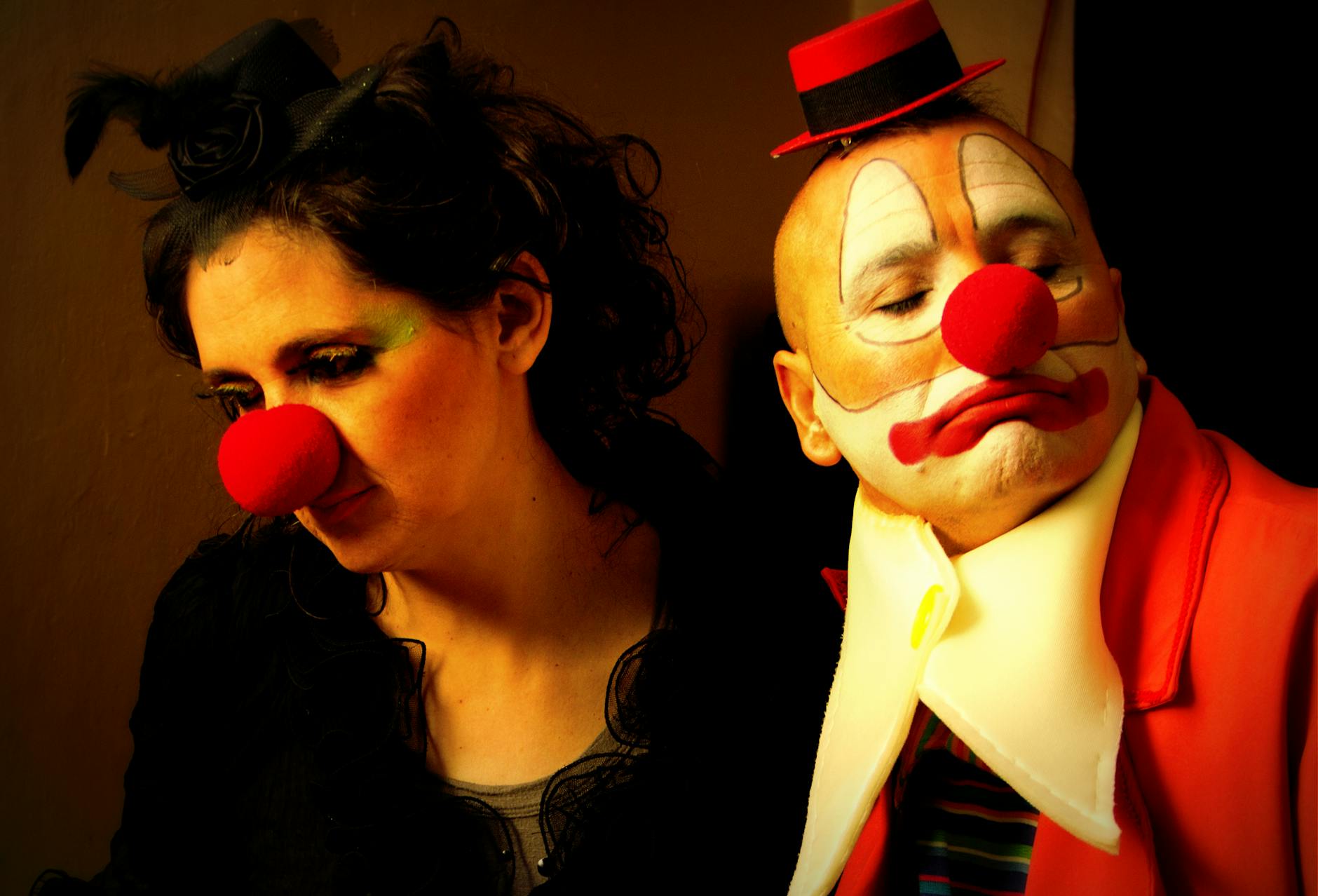
Photo by Capotina Entretenimientos on Pexels.com

Audiences love and enjoy the silliness and absurdity of the clown character. “Clown logic” as a clown tutor said, is the character doing the same thing repeatedly to the point of absurdity”. The clown’s failures by their very nature are a mirror image of our comical attempts at life. Clowning can help us face difficult truths, free us from unnecessary suffering, and allow us to embrace creativity and playfulness. 

The dark side of the fool

The clown or fool’s optimism, playfulness, and innocence have a dark side. Innocence and simplicity are delightful in children. In adults, being ‘simple’ can lead to disastrous consequences. The simple fool is open to any passing impulse, thought, or fad. Simple fools have an oversimplified view of the world. They fail to understand the cause and effect sequences that affect every area of their life. Clowns are like this. A pair of clowns are walking past a hospital and hear a call for a surgeon over the PA system. One clown looks to the other and says: “I could do that.” They decide to put on a white coat and a mask. The clowns then play hospital. The simple fool lacks discernment. They have the ability to sift right from wrong. They can also judge shades of grey when making good decisions. The clown or fool embodies optimism, playfulness, and innocence, but these traits come with a darker side. While innocence and simplicity can be charming in children, in adults, being overly ‘simple’ can lead to disastrous consequences. Simple fools are easily influenced by any passing impulse, thought, or fad, resulting in an oversimplified world view. They often fail to grasp the cause-and-effect relationships that impact various aspects of their lives.

Consider a pair of clowns walking past a hospital. They hear a call for a surgeon over the PA system. One clown turns to the other and says, “I could do that! Let’s put on a white coat and mask and pretend to be doctors.” This shows how the simple fool lacks discernment. They lack the ability to evaluate and judge right from wrong. They also fail to recognize shades of gray when making decisions.

 The tragic side of failure

To attempt or try anything new or different is take the risk of making mistakes.  Some mistakes are much harder to recover and have longer-term consequences.  Playfulness, spontaneity, and a live-for-the-moment philosophy can lead to impulsive decision-making without the thought of long-term consequences. Comedy gives way to tragedy when someone refuses to learn from their mistakes. Tragedy is watching some repeat the same mistakes while expecting a different outcome.  

Reclaiming our foolishness.

We can ‘play the Fool’ or be ‘played by the Fool’. Linguistic distinctions are important. A foolish person lacks judgment. They make poor decisions. Such people often repeat the same mistakes without changing or reflecting upon their behaviour. The disowned fool manifests in repetitive and tragic behaviour. You’ve observed someone at work or in another setting. They seem to be incapable of learning. They fumble their way through making one mistake after another. As an onlooker, their attempts resemble comedy of tragic dimensions. Some psychologists classify this behaviour as a form of narcissism. A narcissist has an inflated view of themselves, verging on grandiosity. A person ‘played by the fool’ resists any attempts to learn from others and refuses to accept help or assistance.

The wise Fool as an ally in the game of life

Acknowledging our “self-deception” is essential for becoming a wise fool. Some honest and painful self-reflection is necessary. It helps in understanding the behaviour patterns that keep us stuck in the tragicomedy of life.  

Playing with ideas

Play helps us to stand outside of the ordinary and experience another realm of life. A realm of possibility and freedom.

Fool’s and clowns play with other people, beliefs and situations.

The Fool’s playfulness is an invitation to a more creative and experimental approach to life. Fool’s of the world unite, you have nothing to lose but your chains! Slavery to social conventions and fear of taking risks is optional. The Fool or the clown can be our ally in taking us beyond our fixed opinions and ideas. In the realm beyond `judgment’, the Fool wants to understand ideas, behaviours, and conventions. These elements play a significant role in our lives. The Fool does this without `making them wrong’. Like the baggy clothes on a clown, some beliefs are ill fitting and awkward. They serve a purpose. But over time, beliefs can be a coping strategy that is maladaptive. They cease to be helpful and may stifle our growth, flexibility and potential to enjoy life.  

The role of play.

Play is hard to define. Play is something to be experienced. Play can be any activity or past time that is enjoyed for its own reward. Play focuses more on the journey or means. It is less concerned with obtaining outcomes or finding the most efficient way of completing a task. Play helps us to stand outside of the ordinary and experience another realm of life. A realm of possibility and freedom. The freedom that comes from identifying our beliefs, questioning them and holding them lightly.

Comics, clowns and jesters play with ideas. They hold them lightly. A clown may grab a piece of furniture and use this as a prop. A jester uses mirth and comedy. They skewer and provoke figures in authority. They highlight the weaknesses of the Ruler or other figures in authority. The Jester can get away with this because they can help the ruler to laugh at themselves. We can be similarly inspired. We can examine some of our beliefs and start to play with them. To question our own attachment to `looking good’, being `perfect’ and wanting to project a flawless image. `What if, like a costume, I tried on a new behaviour?’, explored and played with being the opposite?

Self-compassion: being gentle with ourselves and our beliefs.  

There was a popular TV show in my teenage years. It was about a group of engineers who worked to defuse unexploded bombs during World War 2. In some episodes, the tension was palpable as one mistake could literally explode in the face of the military engineers. There are some beliefs that are formed on the bedrock of traumatic or horrible early life experiences. These are best approached with some caution and professional help. People with a trauma experience are often tempted to adopt an `all or nothing’ approach. It is wiser, regardless of your background, to start small and take calculated risks. There are beliefs that shape our behaviour that are mildly neurotic, annoying and frustrating. One of the most common beliefs is that making mistakes or failure is bad.

The fear of making mistakes doth make cowards of us all! (to paraphrase William Shakespeare).

This fear helps drives perfectionistic behaviour. Fear of making mistakes can lead us to shrink back, stifle our freedom to take risks beyond our comfort zone. One of the most potent and annoying beliefs that keeps many people in chains is that making mistakes is bad. This fear-based belief is probably more responsible for keeping many of us from trying new things. I heard a sage-like person comment that `fear relates to loss’. At the heart of fear is the loss of something that is important to us. Looking incompetent, `amateurish’ or `foolish’ is part of the pathway of learning to master or attain competency in any area. For many of us, there is a struggle. We wish to try something new, but we are haunted by the fear of looking bad or incompetent and inviting ridicule.

Play is a way to reconcile opposites and reduce inner conflict.

I have always liked Shakespeare and wanted to busk in the local Mall. I have a strong, critical voice. It likes to shame me for making mistakes. It whispers in my ear, `What will other people think?’ Trying to ignore the critical inner voice never worked. Like the ghost of Hamlet’s father, the inner critic appears long enough to cause distress and discomfort. I tried a different tack: `What if I did a Shakespeare recital in the public and did it really badly?’ Instead of memorising lines, I would read from a script in public. I shared the idea with friends and they were caught up in the slipstream of my enthusiasm. We created a performing troupe for one evening. We called it `The Really Awful Shakespeare Company.’

As we read from Hamlet and other works, with no attempt at perfection, the response was amazing. Free of our critical inhibitions to be `good’, `perfect’ and looking very `foolish’, some other people stopped to listen. Two young adult males approached us. A woman also joined them. They said: `You look like you’re really having a good time…what are you doing?’ This happened several times. Some onlookers joined in sharing their fleeting knowledge of quotes from Shakespeare they remembered from school. This was an experience of festivity outside of the temporary constraints of social conventions and fixed opinions.  

  • Step out – pick an area of your life that you want to explore. Where do you feel lacklustre, stifled and lack expression?
  • Choose your level of risk. Pick something small (larger level risks can have negative consequences that can end in regret. I will explore this topic in future blog post)
  • What are the beliefs behind your inhibition?
  • How do they serve you? What are the positives?
  • Pick something you want to try and do it poorly. Revel in this until you can enjoy failing. Fail magnificently!

Becoming a `Wise Guy’: life lessons from the Godfather.

Part of Don Vito Corleone’s appeal is the raw exercise of power. He can swiftly execute `justice’ with violence and brutality to achieve his ends. As an audience, it’s like we are willing to `turn a blind eye’ to the `ends justifying the means’ in awe of the Don’s power. It’s like looking into a mirror and catching a reflection of ourselves.

The Godfather trilogy has an extraordinary appeal to movie audiences. The first Godfather movie narrates the later years of the aging family patriarch, Don Vito Corleone. His son, Michael, succeeds him as head of the Corleone crime family. In the final movie, Don Michael Corleone is constantly frustrated in his attempts to move from organised crime to legitimate business. For the aspiring `wise guy’, there are numerous practical life lessons we can learn. In the words of Don Vito Corleone, I will `make you an offer you can’t refuse’ by exploring the practical wisdom of the Godfather.

Fictional characters as `mentors’ and role models.

Whether they are aware of it or not, viewers mimic the attitudes, values, and behaviours of fictitious characters. Many young guys were drawn to gangster-like figures, I observed in my past work in the criminal justice system. One young Australian man expertly mimicked the accent of Tony Montana from the film “Scarface” with an almost faultless imitation Cuban accent. He was the typical Australian “Larrikin.” He had a provocative sense of humour, was very honest and despised authority. His enormous strengths and magnetic personality had a drawback.

Violence/aggression as a `strategy’.

He was a staunch advocate of using aggression and violence to get things done. It is simple to pass judgement on this young man’s practical outlook on life. Although I don’t support violence, the young larrikin didn’t try to hide his opinions. I admired his honesty. There is something appealing about the raw exercise of power that is attractive (and disturbing). The Don was infamous for promptly enforcing “justice” using brutality and bloodshed to further his goals. In awe of the Don’s strength, it’s easy to “turn a blind eye” to his “the ends justify the means’’ approach to life. It’s like seeing a reflection of our darker selves in a mirror.

What Mafia style fantasies reveal about human needs.  

Daydreams and imaginations are excellent sources of knowledge and a terrific way to become more aware of oneself. Imagination can be one way to reclaim our power. There are many situations in life that might make us feel helpless and with no or little control. Bosses that micromanage our work, receiving a ticket from an over-zealous parking inspector or a loud neighbour’s late-night music playing. We may have a sense of powerlessness and disdain in any of these circumstances. As Don, we can “send the boys around to rough up” challenging bosses, the irate parking inspector, and challenging neighbours in our imaginary world.

Self-awareness and re-directing our impulses towards peaceful behaviour.

Self-awareness is crucial while attempting to decipher the meaning of our daydreams. Non-violent communication practitioners think that emotions like anger or irritation point to deeper unmet needs. It is possible to understand the motivations behind these wants and use them for good. By acting, whether it’s having the honest talk with a neighbour or supervisor or strategizing about how to locate a new job, we may make use of the Don’s power and resolve. By being self-aware and bringing our desires to light, we gain the ability to make stronger decisions.

Being conscious of our genuine emotions and wants is the first step to becoming more fully alive. Even when they stem from the “evil side,” those emotions and impulses. We can learn a lot about ourselves by examining our feelings and wants. I’ll discuss the importance of having a “consigliere,” a reliable advisor, or getting smart advice from a wise guy, in my next blog entry.

Games Religious People Play

Through the eyes of the Fool, I am going to explore games that religious people play.

Photo by Daniel Clay on Unsplash

As a young child, I had a growing interest in spirituality. My (adoptive) parents believed in the importance of being raised in the catholic faith. Religion (of any kind) is a thorny area. Loved by some and loathed by others as oppressive. As a teenager, I had a part time job at Woolworths. Every Saturday, I dressed in a white, short sleeve business shirt and black tie. I would get on my bike and travel to and from work. One afternoon, I was peddling back from work. A small boy pointed at me. He said to his friend: `there goes one of those religious fanatics.’

Religion provides a body of traditions, beliefs, and practices that people are socialized into as part of a religious community. At its best, religion inspires people to live for a bigger story rather than owning their interests. At its worst, religion can be tedious and unpleasant. Like milk that sours when exposed to the midday sun.  

I want to have a Fool’s look at religion…yes…the good, the bad and the ugly. As the old saying goes…people in glass houses shouldn’t throw stones! Alright, I’ll `man up’ and take it on the chin. I have also ventured over to the `dark side’ of my own religious practices and lived to tell the tale. Through the eyes of the Fool, I am going to explore games that religious people play.

  1. Do More and Try Harder.’ (DMATH) Karl Marx, the atheist philosopher, said religion was `the opiate of the masses.’ If so, then DMATH is an equal opportunity religious game. Whether rich or poor – anyone can play.  DMATH is the solution to every problem you are experiencing with your spiritual life (and life in general). If you are not getting the result you want, try to increase your efforts. If things are not as expected, work harder. `Do More and Try Harder.’ About 25 years ago, I participated in a bible study group. That’s when a woman named `Miriam’ admitted feeling depressed and anxious. Another woman in the group scolded her. She said, `The problem is that you’re not reading your bible enough!’ Miriam’s depression and anxiety decreased when she learned to be more vulnerable with other non-judgmental people in the parish. Another expression of Do More and Try Harder is:
  2. Put on a McHappy Face and Sing. (POMFAS) During a really difficult phase of my life, I had experienced a major depressive episode. I would leave church early to avoid listening to the praise and worship music. The light fluffy, sentimental lyrics and `la dee da’ tunes added to my pain. An elder in the church criticized me. He said, ‘You better get used to it. This is what you will be doing for eternity!’ Seriously, singing those sickly sweet, syrupy, sentimental love songs of the `Jesus is my boyfriend’ type forever sounds unbearable. It seems like a form of slow torture! A lot of contemporary worship music is like eating fairy floss on an empty stomach. After the first sugar hit, you are left feeling dissatisfied, hungry and with a queasy feeling in your stomach. Healthy religion encourages people to bring their whole selves (including sadness) to God.   

3. Global Citizen. Global Citizens play a larger game in response to climate change, poverty and injustice. They are motivated to travel and advocate for some of the most disadvantaged people in the world. The game becomes unhealthy when global citizens lecture the `peasants’ on the evils of consumerism, overseas travel and middle-class entitlement. Social media offers many chances for global citizens to `share their pain’. It helps to educate the ignorant, uneducated, and apathetic. Oh…and that trip to Bali…don’t even think about it peasant! Jesus had some confronting words for people who `play act’ while ignoring their own faults.

4. We’re a friendly church. Like most games, this usually has a positive start. A church congregation aims to welcome new people. They make a statement on their website that says, ” We’re a friendly church. As the congregation (or parish) grows, people form friendships and become comfortable with each other. New people who visit often find that existing church members are unfriendly, inhospitable, and more like a private club. Long-standing church members struggle to understand how newcomers experience them as unfriendly. `We’re a friendly church’…they think to themselves as they generalise from their own past experience…oh…and…um…It’s also on the church website.

An invitation to Play the Fool.

Photo: Scott Webb at Unsplash.

The Fool is an invitation to the aliveness, pleasure and play we experienced as children. Play is something we do for its own intrinsic reward and pleasure. Play is hard to define. However, pleasure, enjoyment, and fun motivate the wish to play. Children have a natural ability to play. They use play as a dress rehearsal for life. A towel becomes a superhero cape. It gives the child the belief they can leap off a building without getting hurt. A band-aid is the perfect remedy. They discover that even with a pretend superhero cape, jumping out of a tree results in a grazed knee. Children experiment, try on different personas, play `dress ups’ and have a good time.

I was leaving the office after a busy day at work. I watched a young child jumping in and out of the electronic sliding doors. His face was radiant with joy. He moved in and out of the sliding doors. He laughed out loud as if saying `I can get out before you try to close on me.’  Children can always find the `game’ or opportunities for play in any situation.

Play exists in the realm beyond right and wrong and `judgement’.

Ask a young child `can you sing?’ and most will respond enthusiastically with a `yes.’ The quality of innocence in young children leads them to believe that anything is possible. Childlike simplicity sees the good in everyone and is optimistic. They have a sense of wonder and delight in the world. Young children have not been socialised to critically evaluate themselves. Evaluation or judgments without grace stifles play and limits possibility. Play is possible in the absence of making harsh judgments of ourselves, our situation and other people.  

Play exists in the space in between right and wrong without making right or wrong, wrong. Imagine a scene at a local night club or dance venue. The DJ is playing music. You look around and become aware that no one else is on the dance floor. You feel the urge to get up and dance with you partner. The critical voices in your head whisper silently:

`Don’t do it…you can’t dance…what will other people think?

`You’ll look like a dork!’

You will make a fool of yourself!

Remember what happened the last time you took a risk?’

The voice of the Fool says `it’s ok to play.’ Play exists when you listen to your own wishes and ignore the critical voices urging you to stay seated. Letting go of self-criticism helps you enter the realm of play. Releasing the real or imagined criticisms of other people also grants this access.  

Play gives us permission to explore. 

Young children play naturally because they are (mostly) innocent of the problems of the world. If you are prone to cynicism, give yourself a rest and explore the `dark side.’ 

This is no serious feat in a world of 24/7 news and information. Take the opportunity to drink the tonic of innocence. This will help you to get into the frame of mind to play. We can `play for situations, ideas and other people. Sometimes we just need a kick start to get into the mood for playfulness and humour. Seriousness behaviour as a fixed habit can be unlearned. Playfulness and the ability to hold serious things lightly is possible.

Tips: what I have found helpful.

  1. Pay attention to your diet of media, reading and entertainment. Explore the `dark side’ – look for more innocent input. You Tube is a great source of comic videos on clowning and other types of more innocent humour.
  2. Grab a copy of the children’s book, `The Emperor’s New Clothes’, by Hans Christian Andersen. The story is a very humorous example of the power of innocence to accurately see reality without cynicism. 

Failure: the `foolish’ pathway to learning.

…in the ‘clown’s universe’, failure is the gateway to resilience, playfulness and success!

Failure is horrible.

No one likes to fail.

 Some people are gifted or downright fortunate- sailing through life making every post a winner- but for most of us, we’ll probably experience more failures than successes. I still squirm with embarrassment when I think about my first attempt to ask a girl out on a date in my early teens.

“No” she said.

“I have a boyfriend… you would really like Peter if you met him”.

Oh how comforting! I thought. I wanted to crawl under a rock and never come out again. Another two years would pass before I would find the courage to ask another girl out on a date.

My embarrassing story is just one of millions. I have seen some people shrivel up due to self- criticism, or the shaming and scolding of unsympathetic peers. `Wounded spirits’ have a difficult (but not impossible) task of finding the inner motivation to cross the next steps of their personal journey. Some people however, develop the resilience to thrive and throw off the shackles of self- criticism and shame that binds them from the kind of risk taking that leads to growth.

Embracing failure… like a fool.

In my journey discovering myself as a performer and eventually experimenting with clowning, I discovered that in the ‘clown’s universe’, failure is the gateway to resilience, playfulness and success! I discovered that unlike the real world, Clowns have this magical quality to bounce back with enthusiasm and hopefulness.

In one workshop, the clowning tutor asked our group to come up with a spontaneous 5 minute clowning skit. Before I went on the stage, I saw a portable red fire extinguisher mounted on a bracket on the wall. I thought to myself `I could create some chaotic, slapstick routines using the fire extinguisher as a prop!’

… so of course I grabbed the fire extinguisher and started fumbling with it awkwardly in a contrived slapstick routine.

Stony silence in the room.

I looked into the eyes of my peers.

No one laughed.

The audience was deadpan.

This was the longest 5 minutes of my life… my feeble attempts to exaggerate my fumbling movements were met with deafening silence.

Feeling defeated, I walked away from the centre of the stage… embarrassed by my efforts.

I went to place the fire extinguisher on the wall bracket.

I struggled to re-attach it.

I fumbled badly, not sure what to do next.

I looked to my audience feeling the pain of embarrassment again…

… as the portable fire extinguisher resisted my attempts to put it back on the wall bracket. Now, I was feeling really frustrated!

… Then…

I heard something that really surprised me.

Small bursts of laughter rippled around the room. I looked at my peers – `They’re laughing at me… I’m funny!’ I thought to myself, `What happened…?’ I looked straight at the audience and shared my discomfort. My peers enjoyed every embarrassing moment!

You see, every day around the world, people take off and re-attach portable fire extinguishers onto wall brackets without so much as a comment. The humour came from my awkward struggles to resolve a situation as ordinary as attempting to re-attach a fire extinguisher to a wall bracket. In moments of stress or difficulty, it’s a common human experience to `double down’ and use more effort to resolve a situation. I call this the `do more – try harder’ philosophy of life.

Embracing unmet needs

Someone I met recently made a comment that struck a responsive chord with me – judgments are simply `unmet needs.’ Under the withering and disapproving gaze of the inner critic- are the hidden, unmet needs of the individual. In my experience of clowning, there is an underlying desire to be loved, accepted and appreciated. Paradoxically, people are more likely to identify with and accept us when we don’t hide our failures and vulnerabilities.

Blessed are the poor in spirit.

Through humor, clowns and fools help free us of the ‘props’ we use to hide from ourselves and each other. The clown’s vulnerability invites us to recognise our own vulnerability, folly and frailty. My experience of clowning reminds me of the words of Jesus in the Beatitudes. ‘Blessed are the poor in spirit’’.

Jesus taught that only the spiritually needy would enter his kingdom. The clown and the spiritually poor have this in common. They are both `unmasked’, open-hearted and avoid pride and self-reliance. The clown mirrors the Beattitudes call for a life of authenticity, vulnerability and inner richness. A life that is unconcerned with external appearances and impressing other people.  

Most people who embrace clowning struggle with giving up attempts to be `funny’, `interesting’ and making people laugh. Cleverness usually fails spectacularly, leaving audiences feeling bored and listless, since the clown’s failures by their very nature are a mirror image of our own comical attempts at life. Clowning in life can help us to face difficult truths and free us from unnecessary suffering, and can allow us to embrace creativity and playfulness. 

Embracing a clown lifestyle

Fool wisdom provides an alternative way of looking at life. In the universe of the clown, Fool and Jester, the ordinary takes on a new significance. The ordinary reveals a rich vein of spiritual insight for those who have `…ears to hear and eyes to see.’ As a general principle of comedy: Fools, clowns and jesters take the ordinary, pull it apart and raise it to a new and higher level. Rowan Atkinson’s character- Mr Bean, uses ordinary routines such as getting dressed or brushing his teeth to transform ordinary tasks into comedy gold.

Even if it is fool’s Gold!

Navel gaze time:

  • How do you `do more-try harder’?  What behaviours do you find yourself repeating over and over again that are unhelpful?
  • What’s some alternative strategies to doing more of the same?
  • How can you reframe this experience? What lessons have you learnt? What advice would a wise Fool give you?

Discovering Child-like Joy: Unveiling the Clown’s Universe

If life is a game, then clowns, fools and jesters play a different game.

Clowning is like entering an alternate reality. It started when I enrolled in a summer school clown workshop in Brisbane in 2003. Using a series of activities, the instructor helped us comprehend how truth can be represented via our physical bodies. One of these positions was dubbed “office worker” by him. The teacher asked us to imagine that we had a task to finish. We were instructed to keep little eye contact with the other participants as we moved about the room. The instructor told us to breathe quickly and deeply. I found that the physical posture of an “office worker” is very physically demanding to sustain for extended periods. A strong sense of internal discipline is required. We must force our bodies to `labour’ while being driven by an external goal.

`Emotional labour’ is the phrase that describes the way we discipline our emotions to conform to the workplace. Most front-line positions need employees to deliver “service with a smile.” Front-line employees must manage their true feelings. They need to align their emotional state with the goals and values of the organisation. Emotional labour is the socially acceptable mask we put on to fit in with society. Wearing a mask has certain advantages. A vulnerable person’s faith in the helping professions is damaged when they are treated poorly. A business will likely go bankrupt if its staff is rude or indifferent to customers’ needs. It makes sense to behave in a way that aligns with social norms or business principles. We incur a high cost to internalize the self-control needed to regulate our emotions. I discovered that being an “office worker” for extended periods is very taxing on the body. Not to mention exhausting.

Strolling down the Mall at the end of the day, I sat down to observe people as they were walking. I was in a very relaxed, open, and playful mood. I looked ahead and saw a group of men and women dressed in formal work clothes walking through the Mall.  I felt excitement and joy– an epiphany – ‘they’re in office worker’! This was a transformative moment, a powerful realization that changed my perspective. I wasn’t making any personal judgments about the people walking through the Mall. An ordinary moment yielded a fantastic discovery. It was like watching a performance of street theatre. Like the little child in “The Emperor’s New Clothes,” clowns, fools, and jesters have an “unsophisticated” perception. They “see things as they are” and not how we imagine them.

A clown philosophy

The clown’s red nose is the doorway to an alternative universe. In the clown’s universe, the standard rules of reality are suspended. The energy of the clown is an invitation to freedom. The freedom and joy we experienced as children. The clown is our imaginative, funny, and sometimes disruptive side. “Putting on a character” or “acting” is not what clowning entails. The consciousness arises from astonishment, spontaneity, and childlike wonderment. When we are young, everything seems brand-new and is constantly being discovered and learned. When I was younger, I pretended to have Superman abilities. I draped an ordinary sheet around my neck. Then, I jumped off the roof to soar into the sky. After several grazed knees, I discovered that the law of gravity was “kryptonite” to my fantasy of flying. As grown-ups, we are prone to overthink and create excuses not to be playful. Through the clown, we can rediscover the realm of imagination. In our imagination, anything is possible. It’s never too late for adults to re-experience child-like joy without the bruises!   

In the world and not of the world.

While the clown is vulnerable, the fool or jester is quick-witted and provocative. The Fool or Jester lives alongside the Ruler’s court. Fools exist to deflate or puncture the ego of the King or Queen. They are a living contradiction – `to be in the world and not of the world.’ They use comic humor to soften the blow and say what no one is willing to speak out aloud. They are in the center of power. Still, they rise above the political intrigues of the power structures. This gives the fool enormous power and freedom. In life, the fool unmasks and makes explicit the socially polite games we play that we hide behind.

The ordinary is important

In the clown’s universe, the divine is waiting to be revealed in the day-to-day ordinariness of life. As a general principle of comedy, Fools, clowns, and jesters take the mundane and the ordinary. They pull it apart and elevate it to a higher level. A clown character goes into the bathroom to brush his teeth. He fumbles and loses the toothpaste cap. The clown becomes increasingly frustrated with trying to find the cap  As the audience, we experience his frustration. We laugh at the absurdity of the clown as they try to resolve the problem with ‘clown logic’.  It’s like letting your impulsive, child-like self act freely. You can be joyful without a watchful, critical adult standing over you. Clown logic looks for the most creative, silly and fun path to resolving a challenge. In clown logic, if you are failing, then strive to fail gloriously.

Do more and try harder

In trouble, the clown `doubles down’ by using the same approach with more intensity. This is the `Do More and Try Harder’ approach to life. Meanwhile, the clown is failing gloriously. As a mirror, the clown reflects our absurdities and follies to us. Despite our attempts at being `clever’ or `sophisticated, scratch the surface, and we are all clowns. We have our silly side, our weaknesses, and our vulnerabilities. An ordinary routine has become a story that entertains and provokes. At the moment, the clown disarms our natural defenses with comic absurdity. The clown provokes us to reflect on how we complicate our lives. We keep using the same failed approaches while hoping for a different outcome.

Failure is never the final act

Clowning is a joyous celebration of making mistakes. Clowns fail often. Audiences enjoy watching clown characters fail. Clowns are overwhelmed and never defeated. In the failure and struggle, clowns thrive and show resilience. In clown training, embracing the fear of failure easily translates into ordinary life. The clown invites us to ‘play with our fears’ and enter the ‘scary places’. Clowns, fools and jesters encourage us to let go and accept failure as a normal part of life. The wiser Fool learns from their mistakes. The clown’s innocence and the Jester’s provocation are a gift. They can help us see the obvious, take ourselves less seriously, and play different, more life-giving and enjoyable games. If life is a game, then clowns and jesters play a different game.