
You Don’t Have to Fake It: Spotting Imposter Syndrome and Shaking It Off

Guest author, Chloe Pearson, encourages us to step into our freedom and power.

You’ve probably had that moment. You’re surrounded by smart people. Everyone’s talking like they’ve got it all figured out. A small voice in your head whispers, “You shouldn’t be here.” That’s imposter syndrome talking. It doesn’t care how many degrees you’ve earned. It doesn’t care what your résumé says. It doesn’t care how many nights you’ve pulled off the impossible. It sits quietly in the background, chipping away at your confidence, until doubt becomes your default setting. And if you’re not careful, it makes you second-guess the very things you’ve worked the hardest for. But it doesn’t have to be permanent.

When Doubt Becomes Default

Imposter syndrome usually doesn’t shout. It creeps in slowly, almost politely, but once it settles, it starts dictating how you see yourself. You find yourself questioning whether your achievements were due to luck instead of skill. You might also worry that someone’s going to call you out as a fraud. These thoughts aren’t rare, either. Research shows that over 70 percent of people will experience this at some point, and it doesn’t discriminate. People experiencing persistent self-doubt feel inadequate. They report it haunts them even after promotions. It also affects them after big wins. And the cruel irony is, it tends to hit high achievers the hardest.

Get Schooled, Get Stronger

Confidence doesn’t just appear one morning. Sometimes, you’ve got to build it brick by brick, skill by skill. Going back to school can be a direct way to rebuild trust in your abilities. This is especially true when you’ve felt like you’ve hit a ceiling. Whether it’s a single course or a full degree, education lets you get more out of yourself. It sends a strong message to your inner imposter. A business management degree, for instance, can deepen your confidence in leadership, operations, and project management. It also makes you more marketable. And if flexibility matters, you can earn an online degree at your own pace. You can also study wherever you feel most like yourself.

Perfectionism Is a Liar

If you’re a perfectionist, imposter syndrome can have you in a chokehold. It convinces you that unless something is flawless, it doesn’t count. That mindset turns every tiny mistake into a catastrophe and every success into an accident. It’s not ambition, it’s self-sabotage in disguise. People with overly high expectations for themselves often burn out before they give themselves permission to feel proud. They over-prepare, over-apologize, and overcompensate until exhaustion becomes a badge of honor. If you don’t learn to let go of the impossible standard, you will struggle with imposter syndrome. It will stick around like it pays rent.

You’re Not Them, You’re You

Scrolling through social media can feel like walking into a hall of mirrors. Listening to a colleague list their wins can feel the same. Comparison is a dangerous game because you’re playing with made-up rules. Everyone’s timeline is different, yet imposter syndrome convinces you you’re falling behind. What you don’t see are the insecurities and detours other people hide just as well as you do. Learning to stop comparing yourself to others is one of the hardest habits to break. Yet, it’s also one of the most important. Once you do, you’ll start to notice your own growth—without the background noise.

Talk Back to the Voice

That inner critic? It’s not all-knowing. Sometimes it’s just a collection of old fears in a new outfit. Reframing those negative thoughts doesn’t mean pretending you’re the best at everything—it means giving yourself permission to be good enough. Instead of thinking, “I have no idea what I’m doing,” try, “I’m learning something new every day.” You can interrupt the loop by replacing it with positive affirmations, even if they feel clunky at first. Eventually, your brain catches on that maybe, just maybe, you’re not faking anything at all.

Change the Way You Think About Failing

There’s freedom in not needing to be the expert all the time. People who develop a growth mindset know that mistakes aren’t dead ends, they’re detours. Once you allow yourself to learn through failure, you begin to remove shame from the process. Suddenly, it’s not about proving yourself anymore, it’s about improving. That’s a big shift. And it’s often the very thing that untangles you from the trap of imposter syndrome.

Let People In

This part’s uncomfortable, especially if you’re used to pretending everything’s fine. But pretending gets lonely, fast. Sharing your feelings with mentors, peers, or therapists can be beneficial. The act of naming the fear often robs it of its power. Community doesn’t solve imposter syndrome entirely, but it keeps you grounded in truth. You’re not alone, and you never were. Let someone remind you of that when you forget.

There’s no certificate or speech that makes imposter syndrome disappear forever. It lingers because it’s tied to how we’ve been taught to measure worth—by output, by applause, by comparison. But that’s never been the full story. Your presence, your work, your wins, they’re all yours, whether or not your brain wants to admit it. The only way out is through, with practice, patience, and enough reminders that you’re not just pretending. You’re participating.

Dive into the whimsical world of Foolish Times where adventure, humor, and the mysteries of the universe collide. Explore captivating stories and insights that challenge the ordinary and ignite your imagination!

Is Your Anxiety Affecting Your Child? Clues to Look For and Practical Steps Forward

Photo by Freepik

Guest Author Chloe Pearson

As a parent, you naturally want the best for your child. Nonetheless, sometimes your own anxiety can inadvertently affect their well-being. You need to understand how your stress impacts your family. Learn ways to manage it. This can create a healthier environment for everyone involved.

Understanding Anxiety’s Impact on Family Dynamics

To effectively support your child’s well-being, it’s crucial to educate yourself about anxiety and its effects on family life. Recognizing that anxiety is not only a personal struggle. It is also a familial one. This understanding can help you find out how your own stress does influence your child. By managing your own anxiety, you give a positive example for your child. You show that anxiety is a normal part of life. It is something that can be managed. This proactive approach not only aids in reducing your child’s anxiety but also fosters a healthier family environment overall.

Your Anxiety and Your Child’s Well-being

Understanding how your anxiety affects your child is crucial for their emotional and behavioral health. Research indicates that parental anxiety can significantly increase the risk of children developing emotional and behavioral issues. Interestingly, while parental anxiety is linked to children’s internalizing problems, it does not necessarily correlate with externalizing behaviors. Your anxiety does not directly cause your child to act out. Yet, it can deeply affect their emotions. It can still deeply impact their emotional state. By acknowledging this connection, you can take proactive steps to manage your anxiety.

Create Stability Through Consistent Routines

Establishing consistent routines is crucial in providing children with a sense of security and predictability. By setting specific times for daily activities, you help your child feel more secure and manage their expectations effectively. This approach not only fosters a sense of organization and stability. It also aids in developing self-discipline. Children learn to handle their responsibilities independently. Moreover, adding transition periods between activities can ease the shift from one task to another. For instance, a calming reading session before bedtime makes the routine smoother.

Identifying Common signs

Recognizing anxiety in both yourself and your child is crucial for fostering a supportive environment. Look for signs such as excessive worry, irritability, or changes in sleep patterns in both you and your child. By acknowledging these symptoms, you can take proactive steps to manage anxiety. Practice relaxation techniques together, like deep breathing exercises. This shared approach not only helps in reducing anxiety. It also strengthens the bond between you and your child. This creates a more reassuring atmosphere at home.

Boost Your Career Prospects to Alleviate Job-Induced Anxiety

Your job might be causing you stress and anxiety. If it is, consider advancing your career to improve your mental health. Pursuing further education can open doors to better opportunities, offering not only financial benefits but also improved work-life balance. For example, if you work in nursing and want better working conditions, shifts, and pay, explore nurse practitioner online programs. These programs can position you for a more hands-on approach. You can also see improved pay and hours. Regardless of your career track, online degree programs make it easier to handle parenting and work duties more easily.

Seek Out Calming Family Activities

Engaging in calming family activities can foster stronger connections and give everyone a mental break from daily stressors. Try family yoga, weekend nature walks, or cooking together. These activities can create shared moments of relaxation. They allow both parents and children to unwind in each other’s company. Simple routines like reading bedtime stories can give security. Playing music and having a weekly game night foster togetherness. These activities not only help children feel grounded and supported. They also allow parents to reconnect and shift their focus away from anxious thoughts. This reinforces positive family bonds and enhances emotional resilience for everyone involved.

When It’s Time for Professional Help

Recognizing when to seek professional help is crucial. It is essential for managing how parental anxiety affects a child’s well-being. If a parent notices that their anxiety consistently interferes with family routines, it creates persistent stress in the household. This stress also affects their child’s emotional or behavioral health. At this point, it is time to consult a mental health professional. Therapy or counseling can offer both parents and children the tools they need to cope more effectively. A therapist can help parents explore the root of their anxiety. They can learn strategies to prevent it from affecting their child. The therapist also provides a safe space for children to express any concerns they are internalizing.


Identify and handle your own anxiety. This can significantly improve your child’s emotional health. It also helps create a more harmonious family life. Through education, routine, and proactive management, you can foster a supportive environment where you and your child can thrive.


Dive into the whimsical world of
Foolish Times where adventure, humor, and the mysteries of the universe collide. Explore captivating stories and insights that challenge the ordinary and ignite your imagination!

Beware of Aliens bearing gifts!

In one of my favourite TV series of the 1980’s, ‘V’, humanoid alien visitors arrive on earth to ask for our help. In return, their leader, John, promises to share the benefits of their advanced technology with humanity. The ‘Visitors’ are predatory reptilian creatures disguised as humans. The Visitors are scheming to plunder Earth’s resources while salivating over using humanity as a food source. In one scene, the resistance movement takes over a public event at the Los Angeles Medical Centre where the alien leader is about to announce a cure for cancer. The resistance seize control of the medical centre. The resistance leader, Julie Parrish, rips John’s mask off to reveal his true reptilian nature and says defiantly:

 “The visitors are not our friends…they’ve come to rape our planet and kills us…they are not who they appear to be…’’ she says defiantly to the astonished guests.

While ‘V’ was a ripping good yarn, the underlying premise was interesting. Usually, for evil to succeed, it masks itself or comes disguised as something good and beneficial. I had a similar experience at a party many years ago. After talking with a stranger, he looked at me intensely. The kind of hypnotic stare that snakes give while they slowly circle their prey. Nervously, while making small talk, I said: 

“I want to travel…go back to India…see a few other places I haven’t been’’.

He moved slowly closer to me and without blinking responded.

“Sounds great…you’ll need a big income to fund your dreams’’.

Looking at me with a reptilian stare, he paused and added…Have you heard of `the plan?’

Feeling I was unable to escape, he talked about “sharing the plan” with me. I’ve had previous ‘close encounters’ with people who wanted to share “the plan” and the dream of “financial freedom”. This was another introduction to multi-level- marketing (or MLM) or Pyramid schemes. MLM schemes make money by recruiting people into the ‘business’. People who rise to the top of the pyramid benefit financially from the people at the bottom who buy motivational resources. As a friend said to me “Same old story…they sell the dream of financial freedom through money”. I had a close friend who was ‘seduced’ by the allure of a well-known MLM scheme.

After a robust or strongly worded discussion with the friend who had become ‘possessed’, he stated to my disbelief that you could not fail. Financial freedom is guaranteed if you apply the principles and methods of the “business”. If you work hard enough, you will reap the rewards of financial freedom. If you don’t achieve financial freedom, then it’s your fault. In a cruel twist, the apprentice is blamed if they don’t succeed. The plan is a form of technology that enslaves the willing participant. And plays upon our dreams or desires for a better life. The lie has a power of it’s own. It’s a spiritual force that beguiles or seduces people who want to believe there is a guaranteed formula to make money. Fortunately, the host interrupted the conversation. I had an excuse to leave before he could get his fangs into me.

First contact and a few jokes to break the ice.

If Aliens possess the technology to travel over vast distances of the galaxy, then why don’t they have a highly sophisticated sense of humour! None of the reported close encounters with aliens are funny or even mildly amusing. Aliens, in fiction or stories of close encounters, are usually depicted as highly intelligent or evolved. Humour, according to research, is an indicator of high intelligence.

You would think that a technologically advanced alien race would be very witty. Intellectually, we are like ‘small children’ compared to our more advanced space travellers. Surely it wouldn’t take too much to make us laugh. For a species that are obviously superior and advanced, a few self-deprecatory comments would really build some rapport. I mean, making fun of yourself, is one of the easiest ways of building rapport and putting people at ease.

Some unwanted advice or ‘mansplaining’ to our alien friends.

If my dentist or Doctor can crack a few lame jokes, surely it’s not too much to ask our Alien visitors for a few jokes while they’re abducting people for further study. If Aliens were serious about making a connection with earthlings, then a few jokes or witty comments wouldn’t go astray. At least on earth, we usually offer someone an alcoholic drink or a hot beverage as social lubricant or ice breaker when getting to know people. And another thing. Many abductees tell horrifying or really scary stories of aliens taking skin tissue or organ samples. I really don’t get it? What do they do want with all the human tissue samples? Are they trying to build a human being out of spare parts? How about some empathy? On earth, we don’t kidnap people against their will, strap them to a table and examine, poke and prod them with needles and suction devices. We have consent laws on this planet!

Outer space or closer to home?

Not all the researchers of UFO phenomena believe view that a race of technologically advanced beings have been making visits to our planet. Bucking the conventional explanation, French astronomer, Dr Jacque Vallee put forward the ‘multidimensional visitation hypothesis’. Dr Vallee theorized that extraterrestrials were not visitors from outer space but spirit-like beings from other dimensions beyond our time and space. Like ghosts, visit undetected while co-existing with humanity. Nonetheless, explanations in the realm of the ‘paranormal’ are usually dismissed or excluded as a possibility.

Calling occupants of interplanetary craft

After many frustrated and unsuccessful attempts to communicate telepathically with alien beings, I became resigned to living on planet Earth. Maybe it was a way of channelling my emerging adolescent energy into something bigger than my own day to day concerns. While I was too scared to talk to members of the opposite sex, I was not afraid of making a close encounter of the third kind with alien beings. This was less intimidating…even in the face of scary testimonials of abductees being experimented on, taken aboard a flying saucer and being subject to strange and unusual medical examinations.  Nothing compared to the sheer terror of trying to make small talk with a member of the opposite sex…who…may as well have been aliens as they were a complete mystery to me. After reading some disturbing accounts of close encounters, perhaps, I was lucky not to have my wishes fulfilled.  

The lure of occult mysteries

mystic woman with candles and divination cards
Photo by Mikhail Nilov on Pexels.com

There was a natural progression and overlap with the occult as I sought to uncover the hidden mysteries of the universe. Like many searchers, I put these ideas on a pedestal to worship, admire and organise my life around. After many unsuccessful attempts to communicate telepathically with aliens, I moved deeper into investigating occult practices. The occult held out or had the promise and potential of exercising more personal power to effect change in the circumstances of my life.  The promise of more personal power or self-efficacy is the same the catalyst that motivates me to embrace the entrepreneurs journey.

Next blog post: A prophecy in ‘Babylon’.

The Alien conspiracy begins

What if, at a certain point in our development, we stop being human and start to resemble the hideous monsters from our darkest dreams and cease to resemble anything remotely human?

The benevolent or “Christ-like” alien figure of film has a darker side. Not all aliens are like the naïve and adorable Alien “ET” from the early 1980s Steven Spielberg film of the same name. Many of them, as depicted in movies and books, are nasty, mean, and downright unpleasant. Like the irritating friend who abruptly declares, “I’m a vegan,” while you’re grilling steaks for the family barbecue. Hollywood stoked the public’s fear and anxiety toward extraterrestrial visitors through movies with overt and covert plots by aliens to invade, plunder, or conquer Earth. Adding to the public angst, are the stories of people claiming to have been abducted by curious alien visitors.

Close encounters of the third kind and a free colonoscopy!

Imagine the excitement, at the possibility of first contact with alien beings. You then discover, to your horror, that your new alien friends want to extract samples of your skin, probe you with sharp needles, and give you a free involuntary colonoscopy. Maybe authors of science fiction are bringing us back to earth. As a child, I wanted to believe that extra terrestrials might be our human counterparts at a higher evolutionary stage of development. Perhaps aliens, both in fiction and in reports of first contact, embody the darkest aspects of human nature. What if, at a certain point in our development, we stop being human and start to resemble the hideous monsters from our darkest dreams and cease to resemble anything remotely human?

Photo by L. F on Pexels.com

The Martians invade Earth.

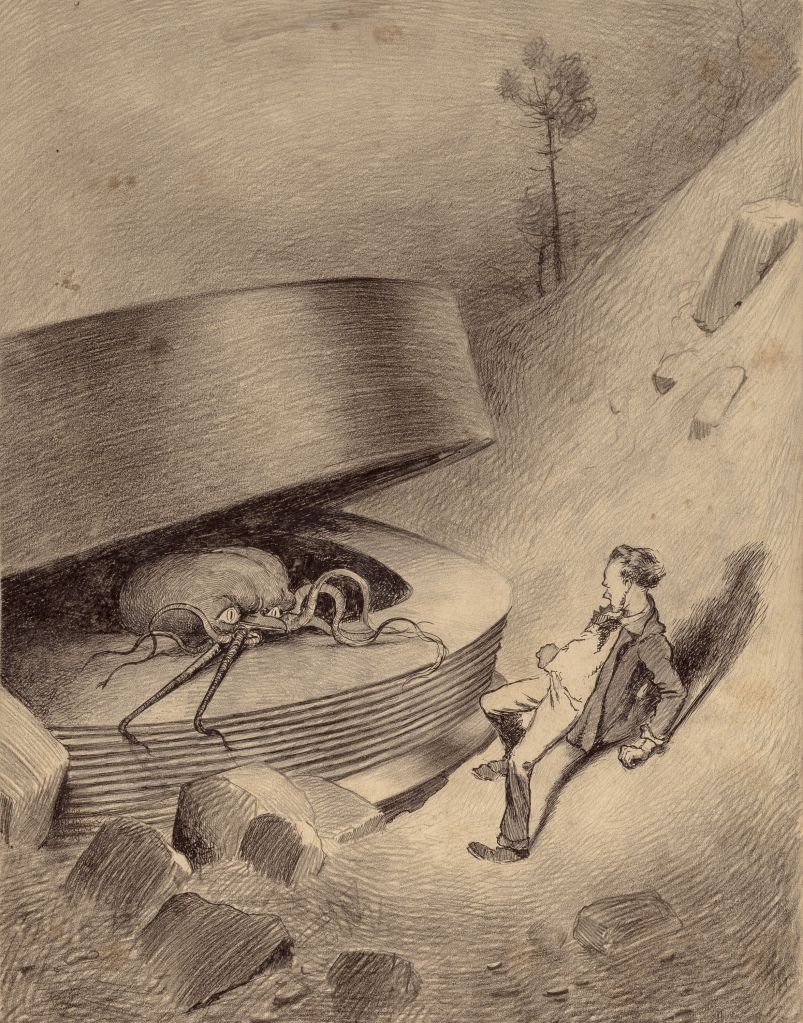
The Martian invaders in H.G. Wells, “War of the Worlds” had huge eyes and tentacles, much like giant octopuses or squids. In the novel, the narrator describes how he was gripped by `ungovernable terror’ as he `…stood petrified and staring’ as he caught his first glimpse of the Martian ascending from the cylinder. In the narrator’s words, as he was ` …overcome with disgust and dread’, he paints an unflattering portrait of the Martian invaders.  

“Two large dark-coloured eyes were regarding me steadfastly… There was a mouth under the eyes, the lipless brim of which quivered and panted, and dropped saliva… A lank tentacular appendage gripped the edge of the cylinder, another swayed in the air. Those who have never seen a living Martian can scarcely imagine the strange horror of its appearance. The peculiar V-shaped mouth with its pointed upper lip, the absence of brow ridges, the absence of a chin beneath the wedgelike lower lip, the incessant quivering of this mouth, the Gorgon groups of tentacles…”

Art work by Henrique Alvim Correa in the public domain.

There is something `otherworldly’ about octopus and squids that inspires the imaginations of scriptwriters and authors. Tentacled aliens have also appeared in Dr. Who, Green Slime, and Invaders from Mars. Some representations of extraterrestrials, such as the alien visitor in “Close Encounters of the Third Kind,” resemble preschool Play-Doh with puny arms and legs. Not exactly a danger to anyone! These guys don’t go to the gym much to “work out.”

The muscular fightback begins.

Photo by Victor Freitas on Pexels.com

In stark contrast to the puny aliens featured in movies was an ad campaign by the Italian American bodybuilder, Charles Atlas. Atlas (or Angelo Siciliano) was a sickly Italian immigrant who became fit through bodybuilding in the early to mid-twentieth century. Atlas is credited for helping to transform the lives of many, particularly young men, through bodybuilding and fitness in the United States.

Atlas promoted a program called `Dynamic Tension’ for bodybuilding. The ad featured a cartoon strip that told the story of the main character, a skinny guy named Mac. Walking along the beach with his girlfriend, a buff, muscular young bully insulted Mac and kicked sand in his face. Mac decides to embrace a weight-lifting program sponsored by Charles Atlas. After transforming his body through weight training, Mac punches the bully and wins the respect of his girlfriend.

As a higher-evolved species, the Aliens probably wised up. Gym memberships are expensive and time-consuming. Why spend hours in the gym when you can incinerate some uppity earth person with a high-intensity laser weapon? On a slightly more cautious note, if Extraterrestrial beings do exist, I really hope there not highly sensitive or easily offended. If they are, I want to offer a public apology on behalf of my fellow citizens of planet Earth. I hope you don’t any of my negative comments personally….you know about resembling octopus…being puny…and other ill-informed words. In earth terms, I’m `less evolved’ and hardly representative of the human race. In fact…I’m thought as ` a bit thick’ to use an Australian colloquial expression ‘between the ears’.

Follow up post: Beware of Aliens bearing gifts.

Utilize These Strategies To Banish Stress

Guest author, Chloe Pearson.

In today’s dynamic and fast-paced world, stress is an omnipresent aspect of our daily lives. But there is hope amidst the chaos: this guide, courtesy of Foolish Times, stands as your lighthouse in turbulent waters, illuminating the path with practical and effective strategies to pinpoint and master the stressors you encounter. With each page, you are invited to embark on an enlightening journey, one that leads towards achieving a harmonious balance and a state of tranquil calm. Here, you’ll not only learn to cope with stress but also transform it into a stepping stone for personal growth and inner peace.

Reflective Insights

Embracing self-reflection is key in managing stress. Regularly set aside time to contemplate moments of tension and overwhelm. This introspection aids in identifying stress triggers and patterns in your life, paving the way for a deeper understanding of your personal stress responses and how to mitigate them.

Embracing Mindfulness

Mindfulness is a powerful ally in combating stress. Incorporating practices like deep breathing and meditation into your daily life cultivates a sense of inner peace. Regular mindfulness exercises train your mind to remain calm and centered even amidst life’s chaos, providing a solid foundation for managing stress effectively.

Career Reevaluation

Navigating a stressful career can have profound effects on your overall well-being. If you’re frequently grappling with work-induced stress, it might be time to ponder a career shift. In today’s world, rich with modern advancements, a plethora of online education and training avenues are at your fingertips. These resources can guide you to explore new professional avenues more in tune with your aspirations and stress management capabilities, such as a Doctor of Education degree that allows you to help others. Learn how to simplify your process with this array of digital tools, making the journey towards a career transition less daunting and more aligned with your personal growth and professional satisfaction.

Support Networks

Never underestimate the power of a strong support network. Sharing your concerns and stressors with trusted individuals can be incredibly therapeutic. Engaging in open, honest dialogues with friends, family, or professionals offers fresh perspectives and coping strategies, enhancing your ability to manage stress more effectively.

Setting Boundaries

Establishing and maintaining clear boundaries is essential in stress management. Identifying areas in your personal and professional life that require firmer boundaries can significantly reduce stress levels. A healthy balance between work and personal life, along with respecting your own personal space, is crucial for mental well-being.

Physical Wellness

Participating in physical activities is a highly effective way to combat stress. Whether it’s a brisk walk, a calming yoga session, or an energetic workout at the gym, these activities play a crucial role in easing physical strain and fostering mental tranquility. Consistent physical exercise is a vital element of a well-rounded stress management strategy, providing not only instant stress relief but also delivering enduring advantages for your overall health. Moreover, this regular engagement in physical activities enhances your body’s ability to handle stress more efficiently, leading to a healthier, more balanced lifestyle.Adaptability and Acceptance

Mastering the art of adaptation and acceptance is crucial in the effective management of stress. It’s important to actively reduce or completely avoid situations that consistently trigger stress. In scenarios where control eludes you, embracing acceptance becomes a key strategy. This mindset not only assists in preserving mental equilibrium but also fosters resilience, enabling you to navigate through challenging circumstances with greater ease. Furthermore, this approach cultivates a mindset that transforms obstacles into opportunities for personal growth and emotional strength.

The journey to mastering life’s stressors is not a quick fix but a continuous process of self-discovery and adjustment. By embracing strategies such as self-reflection, mindfulness, career reevaluation, seeking support, setting boundaries, engaging in physical activities, and practicing adaptability and acceptance, you equip yourself with the tools necessary for navigating through stress. Remember, your ability to recognize and tackle stress is a testament to your strength and resilience, leading you towards a more fulfilling and balanced life.

Foolish Times offers blog posts on a variety of topics for the modern reader. Have a look around today!

Step into your Adventure

We need a new kind of explorer, a new kind of pathfinder, human beings who, now that the physical world is spread out before us like an open book with the latest geographical mystery solved and the highest mountain climbed, are ready to turn and explore in a new dimension.

Laurens Van Der Post.

Photo by Alex Azabache on Pexels.com

Travel and the external quest for Adventure

The word `adventure’ conjures up images of intrepid explorers in far-off lands. Traditionally, adventure was the privilege of a select few. Only the very wealthy could fund overseas adventures. There were also incredible risks involved. While getting `Delhi-belly’ during a backpacking trip in North India was a nuisance, some traditional adventures cost explorers their health and their lives. Cheap airfares, the internet and social media have opened up the world in ways that people could not have previously imagined.

In an increasingly interconnected world, exciting new places are being discovered at a furious pace. It’s like time and space have become compressed. Recently, I participated in a webinar with people from around the world including a Hindi- speaking woman from Colorado and an Egyptian man who lives in Cairo. The exhilarating rate of discovery comes with the loss of the old definition of adventure. There are fewer, untouched areas of the planet that have been left unexplored and untouched by tourists.

The age of mass travel opens up the world.

As airline travel began to emerge in the fifties and sixties, the possibility of mass travel around the world became a reality. In the 1960’s, Sean Connery as fictional spy, James Bond, catalysed the imagination of the public as he embarked on exhilarating overseas adventures. James Bond movies have long been able to draw on audiences’ desire for escapism, exotic locations, and danger. Airline travel was still very expensive and a novelty for most people. If airline travel was too expensive, movie-goers could relax and enter the imaginary world of agent 007 as he jetted around the world on assignment.

James Bond (and other fictional heroes) encouraged us to discover many of these locations for ourselves. On my first backpacking trip to Udaipur, (South India) in 1999, I stayed in a hostel. I was exploring the possibility of doing community development in North India. From the balcony, I could see the famed Lake Taj Palace.  The Taj Palace was one of the locations for filming Octopussy. Every evening, the hotel owners placed a well-worn VHS copy of the movie, Octopussy in the video machine to the delight of tourists.

The threshold for adventure increases.

In an age of mass travel, audiences are more sophisticated and have a higher threshold for adventure. Our thirst and craving for new and original or exotic experiences is difficult to satisfy. Bond movies adapted to satisfy the growing expectations of moviegoers for exotic locations. The most recent Bond movie, `No Time to Die’, was set in multiple countries around the world. Finding exotic locations is a real challenge. There are fewer unknown areas, groups, or localities that have not been exposed to the influences of Western culture or tourists.

During the 1980s, I went to see the movie `The Last Emperor’, with a friend. The movie is based on the story of the last monarch of the Qing dynasty in China during the Japanese occupation in World War 2. I looked around to see my friend, Emily sobbing quietly. After the movie was over, I asked Emily why she was crying. A normally chatty and vivacious person, Emily paused to gather her thoughts. She looked at me and said: `I was crying over the end of an era’.  Emily explained that she felt the loss of old-age traditions and exotic locations. A musician once told me: `If you want to get a taste or an experience of traditional music cultures or untouched cultures…you might have better luck in the diaspora s people cling or value their traditional culture more when in a foreign land or new country.

The end of adventure or the beginning of something new?

The absence of undiscovered or novel locations is not the only challenge to traditional notions of adventure. There is also the risk of over-exposure and familiarity. Our innate restlessness, yearning for adventure, and thirst for new experiences can never be fulfilled. Traveling will never totally satisfy a deep desire or longing in our hearts. As a wise man once said, we have “eternity in our hearts,” a restlessness and desire within to be a part of a larger cause or a story bigger than ourselves. The slow demise of traditional notions of adventure presents an opportunity. A challenge to reimagine the concept of adventure.

Life is an adventure:  finding adventure in everyday life through self-discovery.

Photo by Andrea Piacquadio on Pexels.com

A new breed of explorer has emerged: one who looks within and is interested in self-discovery and learning. Regardless of where they live, the true explorer seeks out new experiences and challenges. There are internal adventures that ask us to go beyond our known or fixed concepts, into dark and unpleasant areas, and confront ourselves before we can break through. On his/her journey, the explorer encounters all of his anxieties, causes that have become strongholds or mental prisons. He must overcome his fear of appearing ‘foolish’ before he can become competent and have a genuine chance of changing jobs or improving his relationships. You can make a simple day adventurous by stepping out of your ordinary routine, trying different things and experiencing life in new ways.

In my next blog post, I will elaborate on why re-imaging Adventure will become more important in the next decade.

My personal quest for adventure

Photo by Valentin Antonucci on Pexels.com

When I was in my early teenage years, I started looking for adventure because I was feeling restless and discontented. I was always curious and enjoyed learning about new places, which motivated me to venture outside the realm of what I knew.

Adventure as the discovery of the external world.

In my early years, I thought of adventure as exploring the outside world. In
a  scene from the `Temple of Doom’, Indiana Jones’s sidekick, Short Round, asks him a question about the Shankara stones. Indiana Jones provides a concise explanation of his motivation: “Fortune and glory, kid, fortune and glory.” My fortune and glory were a career in politics. I gravitated to journalism. I thought this would be a practical path to a political career.

While journeying through the external world, I could no longer ignore my interior world. Like a lost traveller, I was overcome by what I
saw. I cautiously moved from the outward to the inner world to navigate through my darkness and confusion in the quest to the `treasure’. The treasure as represented by discovering the purpose of my life.   

The quest for adventure: exploring my internal world.

The unconscious is the land of the internal world. I was a reluctant
explorer, but after a period of travelling in India for 3 months during the
early nineties, I returned home to Australia feeling spiritually distraught,
confused and more fearful than ever before. There was something about this trip that touched a raw nerve inside of me. The pain and confusion of self-sabotage behaviour pushed me to go deeper into my inner world and find out what was going on beneath the surface. My India adventure had peeled back the layers to uncover my inner wounds–but it wasn’t all bad news! A whole new world revealed itself to me in greater depth: one that is mysterious and fascinating. A world expressed through the language of dreams, synchronicity and self- awareness.

Finding the hidden treasure or the `gold’ refined in the fires of
adversity.

I looked inward and found the treasure I had been searching for. In the
fires of adversity, I discovered the gold refined through my struggles. The
precious gold that came from the important life lessons and wisdom achieved along the way developed through facing adversity and uncertainty. Adventure is moving out of my comfort zone beyond what I can control and predict. It is being open to new experiences and the willingness to risk failure. Learning to embrace failure without harsh self-judgment was going to be one of my biggest personal challenges.

The next phase of adventure: the entrepreneur’s journey.

After a particularly difficult time in mainstream employment, I was
increasingly drawn to the idea of self-employment. I decided to commit to the entrepreneur’s journey. Like the promise of buried treasure, the dream began to call on me until I could no longer ignore the call. It could be starting a business, following your dreams, starting a family, quitting a job or following your dreams. There are adventures waiting to be discovered in the day- to- day routines of life.


The Time My Dog Almost Caused a Divorce

We had each lost our sense of self. We each need that autonomy to grow as individuals.

Guest Author Chloe Pearson

I didn’t see it then, but the day I struggled to get off the couch because my dog was sitting on me was the start of my COVID woes, as we call them now. It’s not like she was really holding me down. She’s all of ten pounds. It was that I had let myself go. My back hurts. I was 15 pounds heavier than I’d ever been. My diet was a wreck. I was depressed.

Anyway, I realize now that that was when the irritability began. It was at that moment that I started snapping at my husband for everything, and when we stopped communicating. I wanted to share my story with the Foolish Times blog because I think that we all need to learn to recognize those small moments that change everything.

Let me back up. Before COVID, my husband and I spent every weekend doing something active with our kids. Once they went to bed, we would snuggle, watch movies, and even play the occasional game of Scrabble. Then, out of the blue, everybody was home. All the time. And nobody ever left. So, naturally, we got lazy. I got lazy. While I know that there’s nothing wrong with having the occasional “do nothing” day, I quit running, quit swimming, I quit watching what I ate, and started shoving everything in my face all day long – that was a mistake.

On this day, the kids were playing in the backyard, and I heard them start yelling at each other (red flag number one). My husband and I were on the couch, and I was already annoyed because he was chewing really loud. So I went to get up, and it wasn’t easy. I got mad that he did not immediately jump up to go check on the kids, and I snapped at him by saying, “Do I have to do everything in this house!?” It was the first time I yelled at him, but it wasn’t the last.

Fast-forward. It’s late 2020, he and I had been arguing every day for the last six months, so I called my attorney. She could not see me for nearly four weeks because she was busy. Apparently, we were not the only ones having marital problems. I had also gained more weight, couldn’t get a haircut, and my liquor cabinet was starting to run dry. Looking back, I’m glad that she could not make the appointment because I had another moment that changed my outlook. My youngest asked me why I hated daddy and why I always looked so tired, even though I was sleeping well past breakfast.

I had to make a change, and I started by separating my and my husband’s workspaces so that I could at least have some time during the day when we were not staring at each other. I turned our spare bedroom into my office, and I made sure it was organized and that I put my desk next to the window. That helped. Being on the other side of the house all day felt a little more normal than sharing the sitting room during business hours.

I even started thinking again about starting my own business and what that might look like. I started by brainstorming some ideas in the quiet of my new home office space. Then, I ran a few of them by my husband before landing on one that I wanted to pursue.

Next, I started working out again. I bought leggings – not the cheap “buttery soft” leggings half the women in my neighborhood sell; I needed something more durable that was also comfortable. I also got some new sports bras and a pair of Saucony running shoes (these, for anyone interested).

Our home is in an area with a good walk score, so I started slowly by walking past the closed shops and restaurants. As I gained back my strength and stamina, my walks turned into jogs and then runs. By this time, I could report what businesses were letting people back in and where we might be able to dine outside as a family.

While things were still tense for the next three or so months, I slowly began to regain my energy, and I apologized to my husband for the last year. But, we knew that we needed more than just an apology from me to put things right. He began working on himself as well, so he quit drinking, and all four of us began spending time together again.

As the world began to reopen, he got permission from his employer to go back into the office, and schools finally started taking students back. I think this was huge for the kids because they no longer had to rely on just me and my husband for socialization. After a couple of months, they were more confident and healthier, and were following directions better than ever.

Today, I have lost most of my weight, which has helped me feel better about myself. I’m also meditating every day. My husband quit drinking (and quit eating in the living room!). We have been going to therapy for three months and realize that we love each other very much. Our problem was that we just did not know how to intertwine every moment of our lives together. We had each lost our sense of self. We each need that autonomy to grow as individuals.

While life is still not back to “normal,” I still have my private office, and the kids are not allowed in there. I’m still exercising. And, most importantly, I’ve learned to invest in myself so that I can be a better wife and mom.