
Christmas is a magical time of year. Traditionally, Christmas was a time to reflect on the birth of the saviour, Jesus Christ. For many Australians, spending time with family and friends and enjoying food is the main reason for Christmas. Around the world, Christmas is celebrated by the religious, non-religious and irreligious alike. Whatever the reason, Christmas inspires many of us to be kinder and more joyful. Family tensions are put aside long enough to come together around Christmas dinner. Did someone sneakily sprinkle fairy dust that leads to a change in behaviour? Christmas can also bring out the very worst in people. Some Christmas gatherings are more like trench warfare. Where passive-aggressive sniping and verbal hand grenades are thrown into the conversation. All this served with a side order of indigestion and seething resentment. Whatever the reason, outbreaks of peace and goodwill are possible.
The Christmas truce of 1914
An outbreak of ‘peace and goodwill’ occurred along the Western Front during the first World War. On Dec 7th, 1914, Pope Benedict XV (15th) asked for an official truce. The Pope pleaded with the warring powers. He wished that “…the guns may fall silent at least upon the night the angels sang.” His appeal for peace was ignored. Since the start of the war, Allied and German soldiers had been fighting for 5 months. Thousands of men had been died (including civilians during the German invasion of Belgium). The armies on both sides were now bogged down in trench warfare. In some places, the trenches were no more 30 metres apart. As the Christmas season approached, the weather became cooler and frost appeared on the ground. For soldiers on both sides, this was their first Christmas away from family and friends. Kaiser Wilheim wanted to boost the morale of the German army. He had thousands of Christmas trees sent to the front. If the Kaiser had foreseen the impact of this gesture, he may have had second thoughts.
Silent Night: an outbreak of peace and goodwill
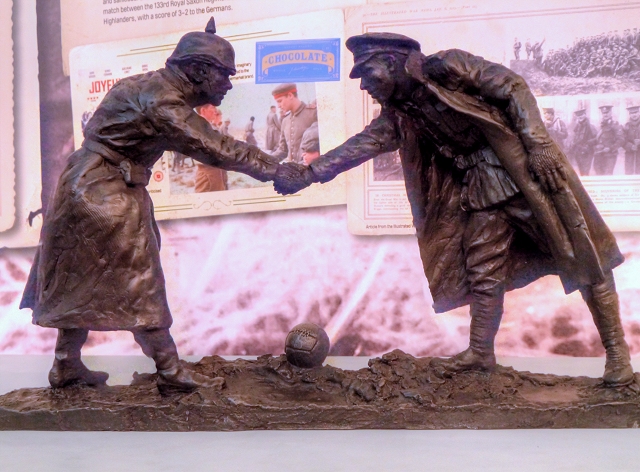
As Christmas Eve approached, an unusual silence descended over the battlefield. German soldiers placed Christmas trees and candles on the edges of the trenches. While German soldiers sang Silent Night and proclaimed ‘Christ the saviour is born’, something unusual happened. The trenches were so close that British soldiers heard the Germans singing Christmas carols. Some British soldiers clapped with enthusiasm in response. Allied soldiers responded singing Christmas carols of their own. Soldiers on both sides had some light-hearted banter with their enemy. The Germans shouted `Happy Christmas’ across the trenches to their enemy.
An agreement was reached to meet in the middle of the battlefield. As trust grew, soldiers from opposing sides, slowly and cautiously, left their trenches. They swapped gifts, drank alcohol, shared family photos, and sang carols together. Some German soldiers offered barrels of beer to contribute to the party. The beer had been ‘liberated’ from a French brewery. Tribal loyalties to their respective nations divided the men. Still, they all agreed that French beer was truly awful. In a joint funeral service, British and German soldiers recited Psalm 23. They said, “The Lord is my Shepherd” to honour their fallen comrades. The truce worked so well that it was extended until Boxing Day. For a moment, soldiers from either side could celebrate. They no longer feared being shot or killed. The ideal of the universal brotherhood of man was realised. What can we learn from the Christmas of 1914 that could make our lives more peaceful?
Conflict and the clash of needs.
Conflict occurs when there is a clash of unmet desires or needs. Conflict can be helpful. Good conflict helps to air grievances and complaints. It allows each other to be heard. It also involves setting ground rules to avoid abusive behaviour. Conflict becomes a problem when parties use manipulation or force. On a larger scale, conflict escalates and leads to war, mass killing, sexual violence, exploitation and genocide. To avoid harmful conflict, we need to listen to our needs. We must also learn to listen to the unmet needs of other people.
Defusing conflict: finding common ground and the role of empathy.
Expressing our own needs and hearing the needs of others creates common ground. In a space free of harsh judgments, blame, scapegoating and fixed opinions, common ground and mutual empathy is possible. Empathy is not to be confused with sentimentality or not having boundaries. Real empathy is the ability to make sense of another person’s behaviour by looking at their situation. This doesn’t imply that we must always agree to meet the other person’s needs.
Defusing conflict with a teenage neighbour
While working from home, a teenage neighbour was playing loud music. I was feeling very irritated, unable to think or concentrate. My need was to have time to concentrate. I put myself in the situation of my teenage neighbour. As a teenager, playing music was one of the ways that I expressed my growing independence and self-expression. I fiercely resented adults trying to impose their will on me. In the short term, using force will lead to conformity. It creates simmering resentment. It doesn’t allow for a conversation that engages the other party in the possibility of cooperation. I walked over to the fence and calmly said ‘Hello’. I explained to him that I was working from home and struggling to concentrate due to the music. I said: ‘I don’t want to stop you from playing your music and having a good time.’ I asked him to lower the volume for the next 2 hours. I needed that time to finish my work. He agreed and I had 2 hours to concentrate and finish my work.
Part 2: Avoid demonizing the enemy.
Resource
1. Nonviolent Communication: A Language of Life : Life-Changing Tools for Healthy Relationships: Vol. 3rd edition – Marshall B. Rosenberg, PhD & Deepak Chopra


 Foolish Times