

‘Watch the skies,’ the wise old scientist said in a scene from a 1950s science-fiction film. And I did! As a “cradle Catholic,” my old religious beliefs were overshadowed by a new religion: Unidentified Flying Objects. When I couldn’t make sense of institutional religion, I looked to the heavens in search of extra-terrestrial beings. There was a rise of interest in Aliens, Unidentified Flying Objects, Bigfoot, and paranormal phenomena in the mid-1970s. My sister handed me a copy of Erik Von Daniken’s book “Chariots of the Gods.” The author’s belief that alien creatures had visited Earth and contributed to humanity’s progress was both alluring and (pseudo) scientific.
I wanted to believe that more intelligent life forms existed elsewhere in the far-flung reaches of the universe. Perhaps they benefited from evolutionary processes. To those of us, on the lower rungs of the evolutionary ladder, alien beings with sophisticated technologies would appear to possess `supernatural’ powers beyond our limited understanding. We, Earthlings, would one day ride the crest of the evolutionary wave and eventually learn to coexist peacefully among ourselves and our alien friends. Throughout my childhood, the threat of nuclear war between the Soviet Union and the West was always in the background. There was always the hope of alien intervention. Perhaps they can assist us in fixing some of our planet’s most pressing concerns. A recurring, hopeful theme in many science fiction films.
Science fiction films and post-war anxieties in a nuclear age.
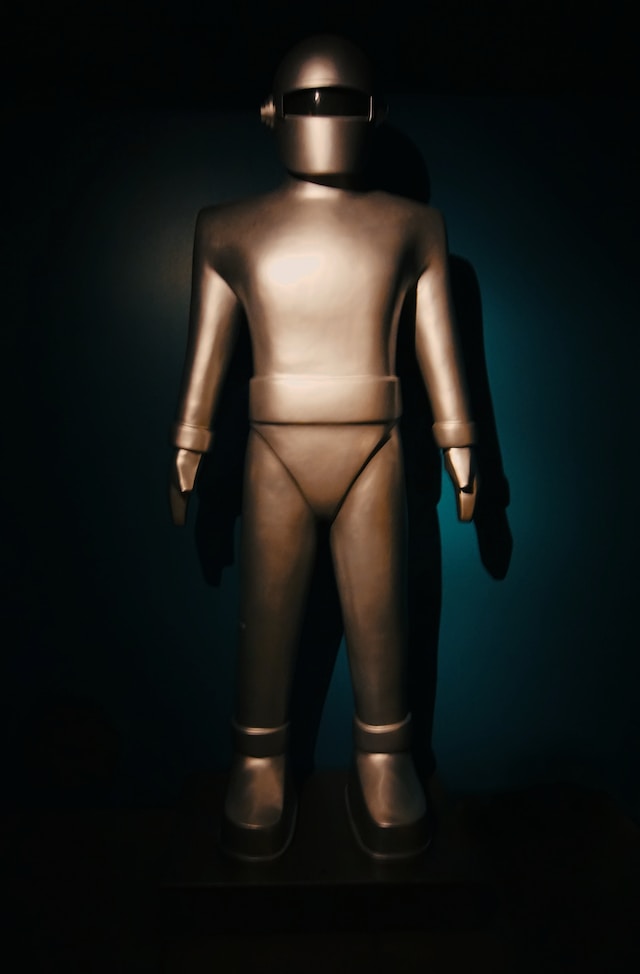
Gort Klaatu Barada Nikto
At the dawn of the nuclear age, one film captured the postwar anxieties of the early 1950s. The plot of ‘The Day the Earth Stood Still’ focused on the arrival of an alien named Klaatu and his robot protector, Gort. Gort descends the flying saucer’s stairway to defend Klaatu after a trigger-happy soldier shoots him in the hand in the opening scene. An intriguing storyline twist is revealed in the closing scene. Klaatu gives a sober warning to the audience of civilians, scientists, clergy, and military. Other races in the cosmos, he claims, are concerned about the human race’s tendency to violence. Klaatu reveals that robots such as Gort patrol the Galaxy, ready to interfere when necessary at the first signs of violence and aggression. To maintain the peace, Klaatu and other aliens have voluntarily become submissive to robots like Gort. In his final words, Klaatu says:
Your choice is simple. Join us and live in peace or pursue your present course and face obliteration.
An unsettling message from one of my favorite sci-fi films. There is an underlying realism. Can humanity ever be trusted to manage our own affairs? Humans are like badly behaved children: we cannot be trusted to govern ourselves and need some `adult supervision’ from a more highly evolved race. During the early eighties, at the height of the peace movement, I remember having a conversation with an older male friend after a Labor party branch meeting. (a Left of centre political party in Australia) The possibility of a nuclear war between the Soviet Union and the United States of America was a topical issue. I clearly remember fretting about the outcome of the 1980 U.S. presidential election. In American terms, I was a liberal and a supporter of the incumbent President, Jimmy Carter. I was disappointed that the Republican candidate, Ronald Reagan won a landslide victory against Carter. As a classic ‘bed wettin liberal’ type, I was almost convinced that Ronald Reagan was trigger happy, like the impulsive soldier that fired at Klaatu. My friend George reassured me that `wiser-heads’ would prevail and the threat of a nuclear Armageddon was over-stated. In 1987, President Reagan negotiated an arms control treaty with the Soviet Leader, Mikhail Gorbachev. What a relief! No more sleepless nights and nightmares of Armageddon. And no need for more `Hollywood style’ alien warnings.
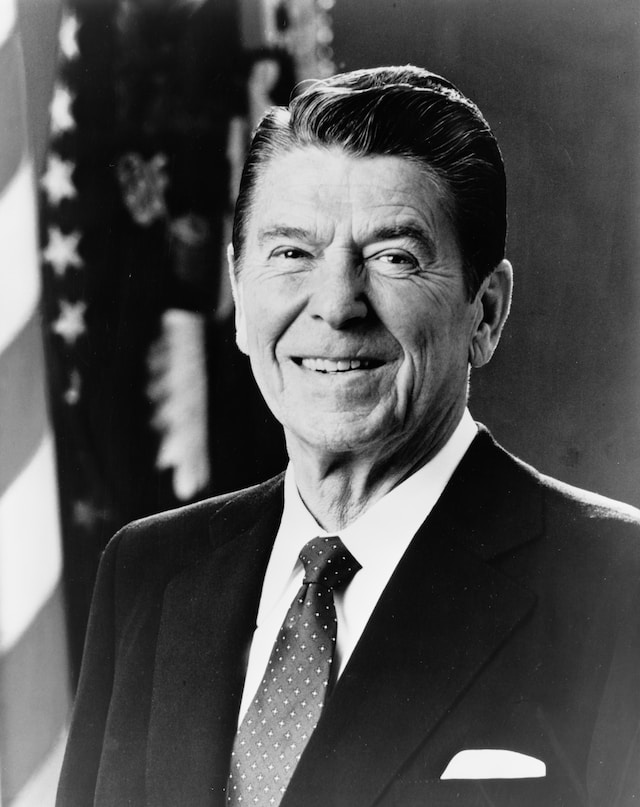
Mr Ronald Reagan, 40th President of the United States of America.
What if the Aliens travelled millions of miles across the galaxy to give us a warning – only to discover we didn’t need their help! Sometimes, we humans get it right! Imagine the Alien ambassador meeting President Reagan at the White House.
Well…gee…it’s quite an honour to finally meet the Ambassador of the National Galactic Council’, President Reagan says in a folksy manner.
Greetings Earth people. I am Zark. We come in peace. We would like to extend an offer of help. We are concerned about the warlike tendencies of the human race. If you would let us…
President Reagan looks at Ambassador Zark and explains:
`Gee…am…uh… Ambassador Zark…we’re doing fine. I just signed a peace treaty with our longtime enemy…the Soviet Union… If we need your help…we’ll call you.
The belief in aliens or some higher intelligence that can save humanity from a terrible tragedy persists. Even now, the appeal of a ‘Christ’ figure like Klaatu is great. On an instinctual level, perhaps most of us still want for a figure larger than ourselves to intervene and restore peace and harmony to our troubled earth. More like a blunt-spoken John the Baptist, who will push us to abandon our self-centeredness and violence in favour of embracing a larger vision of the possibility of a world at peace. The idea of wiser, more intelligent aliens clashes with another possibility addressed in literature and film. ET is not the only type of alien visitor. Some of them are outright rude, unpleasant and nasty!
 Foolish Times